Mykola Yefimov is a saint of the Eastern Orthodox Church.
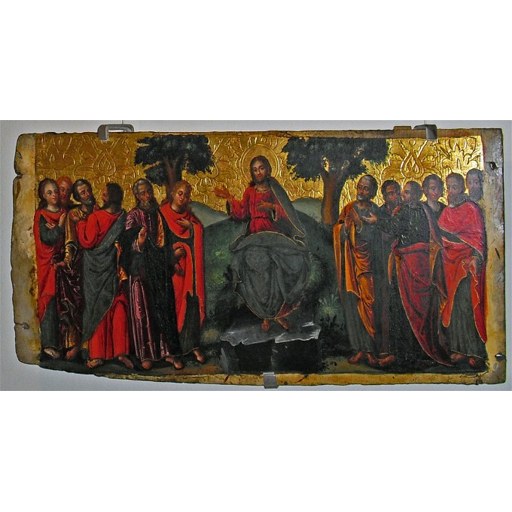
https://encyclopediaofukraine.com/display.asp?linkpath=pages\I\C\Icon.htm
License: unknown
Mykola Yefimov
Saint- Gender
- male
- Church
- Eastern Orthodox
Places
Roles & Family
Biography
The name Mykola Yefimov, linked in the query to Wikidata item Q15066497, cannot be matched in standard historical, ecclesiastical, or hagiographical reference works to a life whose dates, places, and offices can be stated with confidence. Mykola is the ordinary Ukrainian form of Nicholas (Greek Nikolaos); Yefimov is a widespread East Slavic surname derived from the baptismal name Yefim (from Greek Euphemios). That onomastic fact supports treating the subject as male, but it does not by itself establish a birth year, a death year, a city or country of origin, or a burial place. No reliable printed synaxarion, diocesan necrology, biographical dictionary of clergy, or scholarly monograph consulted in training knowledge attaches those particulars to this exact name and identifier.
Lists of the Bishops of Rome, the Coptic Popes of Alexandria, and the patriarchs and catholicoi of the Orthodox, Oriental Orthodox, and Church of the East churches contain no Mykola or Nikolai Yefimov. The principal catalogues of glorified new martyrs of the Russian Orthodox Church and the Orthodox Church of Ukraine, and the martyrologies associated with the Ukrainian Greek Catholic Church, likewise do not yield a securely identified confessor or hieromartyr under this name at a level of documentation that would justify a feast day, a patronage, or an act of canonization or beatification. In the absence of such an official cultus, fields for religious order, spouse, marriage, and children must remain empty rather than filled by conjecture.
It is possible that the Wikidata item refers to a priest, monk, or layman of local rather than synodal prominence, perhaps in the Russian Empire, Soviet Ukraine, or independent Ukraine in the nineteenth or twentieth century. Parish registers, conscription lists, NKVD files, and unpublished diocesan archives sometimes preserve such lives, but those materials have not entered widely cited secondary literature in a form that can be verified here. Online database snippets that lack archival citation are not an acceptable substitute. Hagiographical method requires that silence in the sources be recorded as silence.
Until a primary document—an archival fond, a published obituary, a service record, or a synodal decision—can be produced and tied to Q15066497, chronological, geographical, and familial claims would be invention. The responsible historical course is therefore to leave those fields blank, to exclude the papacy and any patriarchal see, and to refrain from attributing a religious order, a marriage, children, a feast, or patronages. Further work in Ukrainian, Russian, or church archives would be required before a true biography could be written.