Mykolas Giedraitis is a blessed of the Catholic Church (1420 - 1485). Mykolas Giedraitis's feast day is celebrated on 4 May.
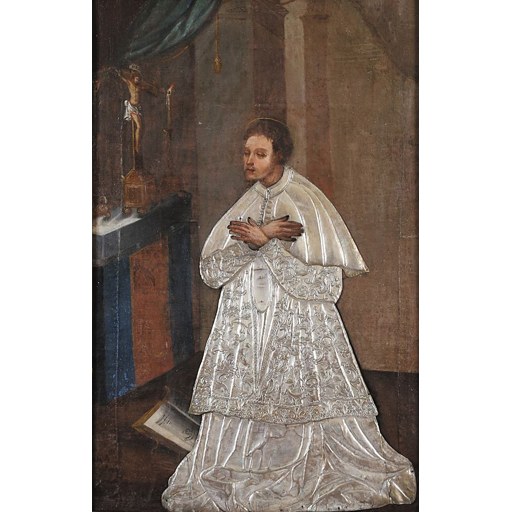
Unknown authorUnknown author. Tentatively attributed to Martin (died in 1647), student of Thomas Dolabella (1600–1650), a court painter from Venice
License: Public domain
Mykolas Giedraitis
Blessed- Life Span
- 1420 - 1485 (age 65)
- Feast Day
- 4 May
- Gender
- male
- Church
- Catholic
Places
Relics & Where to Venerate
Location unknown
The bodily remains of Mykolas Giedraitis are a first-class relic. Venerated at Saint Mark church in Krakow.
Roles & Family
Religious Information
Canonization
Biography
Mykolas Giedraitis (Polish: Michał Giedroyć; Latin: Michael Giedroyc) was a fifteenth-century Lithuanian noble and religious brother of the Canons Regular of the Penitence of the Blessed Martyrs. He was born about 1420 at Giedraičiai in the Grand Duchy of Lithuania, the ancestral seat of the princely Giedraitis (Giedroyć) family, a house counted among the older Lithuanian dynasties and one that later produced bishops and other churchmen in Lithuania and Poland. From infancy he was afflicted with a grave bodily infirmity. Later lives describe him as small of stature and lame, so that he walked with difficulty; the disability was serious enough, in the judgment of his age, to prevent ordination to the priesthood. Of his childhood and youth in Lithuania little that is strictly documented survives, beyond the consistent tradition that he belonged to this noble line and that he sought a religious life despite his physical limitations.
In the mid-fifteenth century he made his way to Kraków, capital of the Kingdom of Poland and a principal city of the Polish-Lithuanian world, where he is reported to have spent some time at the Kraków Academy (the later Jagiellonian University). He then entered the community of the Canons Regular of the Penitence of the Blessed Martyrs, a small congregation of Augustinian canons whose Kraków house served the Church of Saint Mark. The canons followed a penitential reading of the Rule of Saint Augustine. Because he was not ordained, Giedraitis remained among the brothers and was given the office of sacristan, a hidden charge that involved the care of the church, its vestments, and its liturgical life. Contemporary fame and later hagiography agree that he embraced this obscurity. He was remembered for severe personal austerity, prolonged prayer before the crucifix and before images of the Blessed Virgin, charity toward the poor and sick, and a reputation for supernatural gifts, including prophecy. A persistent legend, which cannot be verified as history, holds that the figure of Christ on the cross addressed him in the church. He lived in the same urban religious world as other Kraków servants of God of that century, among them Saint John Cantius and Saint Simon of Lipnica, though the sources do not preserve a detailed record of their mutual relations.
He died at Kraków on 4 May 1485 and was interred in the Church of Saint Mark. Devotion at his tomb began soon afterward; healings and other graces were reported, and both the Giedraitis family and the Kraków canons promoted his memory. An immemorial cult took root in Poland and Lithuania, and he was popularly called blessed for centuries even though the Holy See had not issued a formal decree. After a modern revival of the cause, Pope Francis on 7 November 2018 confirmed the ancient cult of Mykolas Giedraitis, an act that constitutes equivalent beatification. His liturgical commemoration is kept on 4 May. Relics remain at Saint Mark’s Church in Kraków, and he is honored in Lithuania as a native blessed of noble birth who chose humility and the cloister. Surviving evidence for his inner life is largely hagiographical and late; the outline of his origin, religious profession, humble office, death in 1485, and enduring cult is nevertheless secure in the historical record.