Nabor and Felix is a saint of the Catholic Church. Nabor and Felix's feast day is celebrated on 12 July.
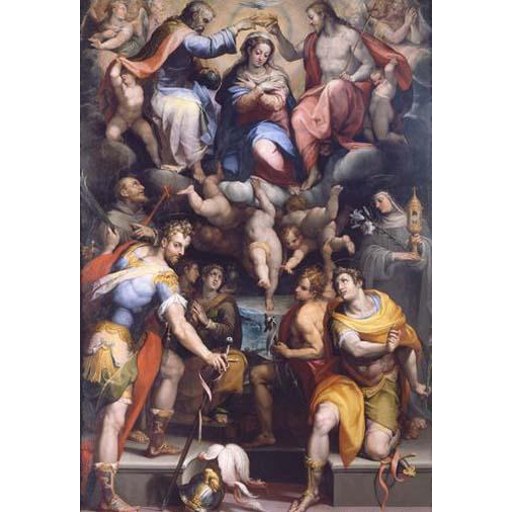
Orazio Samacchini
License: Public domain
Nabor and Felix
Saint- Feast Day
- 12 July
- Gender
- male
- Church
- Catholic
Places
Roles & Family
Biography
Nabor and Felix are early Christian martyrs whose cult is among the most ancient in northern Italy, especially at Milan and Lodi. Surviving historical evidence for their lives is extremely limited. Later hagiographical accounts, which modern scholars treat as legendary rather than documentary, present them as soldiers of Mauretanian origin serving in the imperial army under Maximian. According to that tradition they were arrested for their Christian faith and put to death at Lodi (the Roman municipium of Laus Pompeia) during the persecutions of the late third or early fourth century. The Roman Martyrology commemorates them on 12 July and associates their passion with the persecution of Maximian, but it does not supply a precise year, and no contemporary acta survive. Neither a birth year nor a securely documented place of birth can be recovered from reliable sources.
Their public veneration is securely attested by the later fourth century. Saint Ambrose of Milan, bishop from 374 to 397, translated relics believed to be those of Nabor and Felix from Lodi to Milan and fostered their cult in the city. A basilica dedicated to them, known as the Basilica Naboriana, stood in Milan; in the later Middle Ages it passed to the Humiliati and was rebuilt as the church of San Francesco Grande. The names of Nabor and Felix were inserted in the Communicantes of the Roman Canon, a liturgical honour reserved for martyrs of particular standing in the Roman and Ambrosian traditions. This liturgical witness, together with Ambrose’s translation of the relics, is the strongest indication that an authentic local martyr-cult existed even if the biographical details of the later passio cannot be verified.
The historical kernel, so far as it can be recovered, is therefore that of two Christians put to death in the Milanese region, whose tombs at Lodi became a focus of devotion and whose relics were solemnly brought into Milan in the age of Ambrose. Beyond that, the Mauretanian origin, military rank, and the exact circumstances of interrogation and execution belong to later legend. In medieval and early modern art they are commonly shown as Roman soldiers bearing palms or swords. After the Napoleonic suppression and demolition of San Francesco Grande in the early nineteenth century, relics associated with the saints were redistributed among Milanese churches. Their feast on 12 July remains in the Roman Martyrology, and they continue to be commemorated in the Ambrosian rite and in the local calendars of Milan and Lodi.
Neither any reliable information about family, marriage, or ecclesiastical office nor a record of formal canonization in the later juridical sense is preserved. They were not popes, patriarchs, or members of a religious order; the tradition presents them as laymen, specifically as soldiers. Their cult is pre-congregational, resting on ancient liturgical commemoration and on episcopal translation of relics rather than on a papal decree of canonization or beatification. Specific later patronages attached to them are not extensively documented in the major martyrologies, though they share in the honour paid to the early martyrs of the church of Milan.