Nabor is a saint of the Catholic Church. Nabor's feast day is celebrated on 12 July.
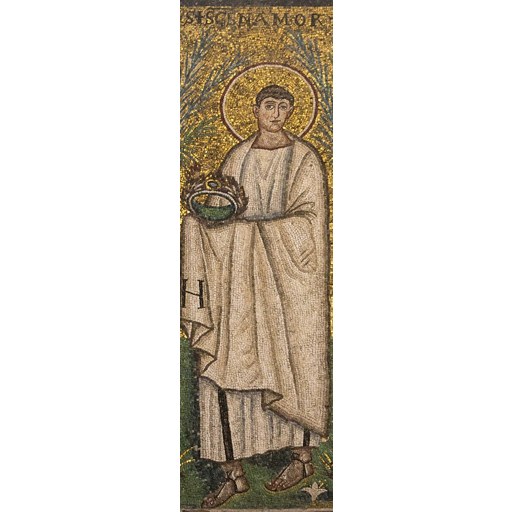
Roger Culos
License: Public domain
Nabor
Saint- Feast Day
- 12 July
- Gender
- male
- Church
- Catholic
Places
Roles & Family
Biography
Saint Nabor is an early Christian martyr of northern Italy, almost invariably commemorated together with his companion Saint Felix. According to the traditional Passio, a narrative that scholars generally regard as much later than the events it describes, Nabor and Felix were soldiers of Mauritanian origin serving in the Roman army under the emperor Maximian. Having become Christians, they refused pagan sacrifice, were arrested at Milan, taken to Laus Pompeia (the ancient city on the site of present-day Lodi Vecchio in Lombardy), and there beheaded. Their bodies were recovered by Christians and brought to Milan for burial. The Roman Martyrology commemorates them at Milan and places their passion in the persecution of Maximian. That persecution belongs to the opening years of the fourth century, and later writers often assign the deaths to about 303 or 304, but no contemporary document records a precise year of birth or death, and the Mauritanian origin itself rests on the legendary acts rather than on independent evidence.
The legendary character of the Passio does not mean that Nabor and Felix are fictitious. Their cult in Milan is among the oldest in the city and is independently attested in the late fourth century. Saint Ambrose of Milan knew their shrine and promoted their veneration; a Latin hymn in honour of the martyrs Victor, Nabor, and Felix is attributed to him. A basilica dedicated to Saints Nabor and Felix stood outside the walls of Milan from an early period, in the western sector of the city later associated with San Francesco Grande. Ambrose’s care for their relics belongs to the same pastoral programme in which he also brought to light the remains of Gervasius and Protasius and strengthened Milanese Christian identity around its local martyrs. Early martyrologies already include the pair, which is consistent with a cult established well before the sixth century.
In later centuries relics attributed to Nabor and Felix were translated, divided, and distributed among churches in Milan and beyond. The medieval basilica remained an important Milanese sanctuary into the early modern period, after which the material history of the relics becomes harder to follow with certainty because of rebuildings, suppressions, and further translations. Liturgical calendars of the Ambrosian Rite and the Roman Martyrology assign their feast to 12 July. They are local Milanese and Lombard martyrs rather than universally assigned patrons of a particular trade, illness, or nation, and no reliable medieval or modern list of distinctive patronages can be verified for Nabor alone.
Nabor is not to be confused with other early martyrs of similar name, nor with the companions of Saints Nazarius and Celsus, a different Milanese group whose relics Ambrose also handled. No reliable evidence indicates that he held ecclesiastical office, belonged to a monastic or religious order, married, or left writings. He was never Bishop of Rome and never a patriarch of an Eastern see. Recognition of his sanctity belongs to the pre-congregational period, when saints were acknowledged by popular cult, episcopal approval, and insertion into local calendars rather than by a formal papal process of beatification or canonization. Modern historical study therefore treats him as a genuine martyr of the Milanese church whose personal biography remains largely unknown, while his liturgical memory has been continuous from late antiquity to the present.