Nectan of Hartland is a saint of the Catholic Church. Nectan of Hartland's feast day is celebrated on 17 June. Nectan of Hartland is the patron saint of Hartland.
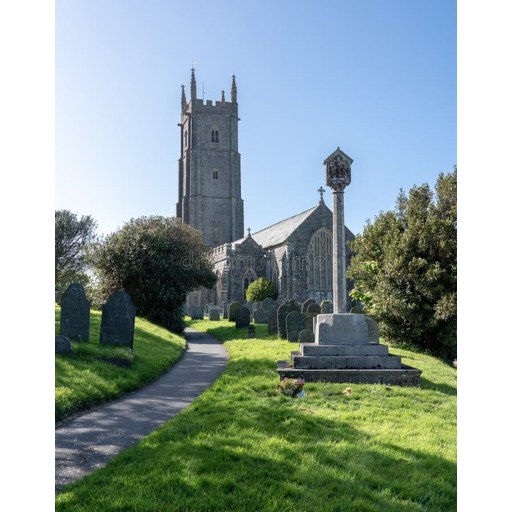
https://dreamstime.com/photos-images/saint-nectan.html
License: unknown
Nectan of Hartland
Saint- Feast Day
- 17 June
- Gender
- male
- Church
- Catholic
Places
Roles & Family
Patronage
Hartland
Biography
Saint Nectan of Hartland is a Celtic Christian saint of the fifth or sixth century whose cult was centred on Hartland in northern Devon. No contemporary record of his life survives. What is known comes from later medieval hagiography, above all a twelfth-century Life written for the canons of Hartland, together with place-names, church dedications, and the long local cult. That Life presents him as the eldest son of Brychan, the legendary king of Brycheiniog in what is now Wales, and thus as one of a large family of holy men and women who, in Welsh and West Country tradition, evangelised parts of Wales, Cornwall, and Devon. Historians treat the Brychan genealogy as largely legendary, so Nectan’s parentage and precise dates cannot be verified; he belongs to the poorly documented generation of western British hermits of the post-Roman period.
According to the traditional account, Nectan left Wales by sea in search of solitude. He landed on the north Devon coast and settled in a wooded valley at Stoke, a short distance from the later town of Hartland, where he found a spring and built a hermitage. He is said to have lived there in prayer and austerity, receiving visitors and giving help to neighbours. One story tells that he aided a swineherd in recovering lost pigs and that the local landowner then granted him the surrounding land. A glen and waterfall near Tintagel in Cornwall (St Nectan’s Glen or Kieve) were later associated with him; whether that Cornish dedication refers to the same hermit as the Hartland saint, or to a namesake or transferred cult, remains uncertain.
Legend describes his death as martyrdom. Two robbers who had stolen cattle linked to the hermit were confronted by Nectan, who sought to convert them; they struck off his head. In the manner of other cephalophoric saints he is said to have taken up his head and carried it back to the well by his cell before dying. His body was buried at the site of the hermitage. In time a church was built over the tomb. The present parish church of Saint Nectan at Stoke, Hartland, occupies that place and long housed his shrine. Relics were later kept at Hartland Abbey, originally a college of secular canons and from the twelfth century a house of Augustinian canons, which promoted his cult until the Dissolution of the Monasteries.
Nectan’s feast is kept on 17 June. He is the patron saint of Hartland. The medieval abbey and the great church at Stoke, whose tall tower served as a sea-mark on a dangerous coast, made him a focus of regional pilgrimage. After the Reformation the formal cult lapsed, but the dedication, local folklore, and place-names preserved his memory in Devon and, more loosely, in Cornwall. Modern historical judgement regards him as an early western British hermit whose true biography cannot be recovered, around whom a rich regional legend and a durable parish cult formed.