Nephon II of Constantinople is a saint of the Catholic Church (d. 1508). Nephon II of Constantinople's feast day is celebrated on 11 August.
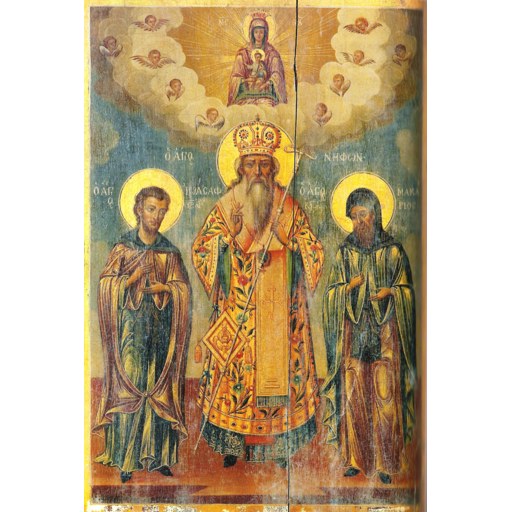
Unknown authorUnknown author
License: Public domain
Nephon II of Constantinople
Saint- Life Span
- d. 1508
- Feast Day
- 11 August
- Gender
- male
- Church
- Catholic
Places
Roles & Family
Canonization
Biography
Nephon II of Constantinople, known in the world as Nicholas, was an Eastern Orthodox monk and bishop of the fifteenth and early sixteenth centuries who occupied the Ecumenical Patriarchate on three separate occasions. He was born in the Peloponnese in southern Greece during the fifteenth century; neither the exact year nor a securely attested town of birth has been preserved in the principal historical notices. Accounts of mixed parentage describe his father as Albanian and his mother as a Greek woman of noble family. He received the monastic tonsure at Epidaurus, taking the name Nephon, and later lived as a hieromonk at a monastery of the Theotokos in the Ohrid region before going to Mount Athos. From that monastic setting he was raised to the episcopate and became Metropolitan of Thessalonica, the office he held before his first election to Constantinople toward the end of 1486.
His first patriarchate lasted until early 1488. Like many occupants of the see in the generations after the Ottoman conquest of 1453, he was subject to the fiscal demands of the Porte, to the need for an imperial berat, and to rivalries within the Greek ecclesiastical elite, and he was deposed. He returned to monastic life, including sojourns on Mount Athos. He was restored as patriarch in 1497 and served until 1498, then was elected a third time in 1502, holding the throne only briefly. Surviving sources do not always agree on the precise motive for each removal, but they agree that his tenures were short and that deposition and restoration were then ordinary features of patriarchal politics rather than exceptional scandals.
A substantial part of his later public work took place in the Danubian principalities. Invited to Wallachia by Prince Radu IV, called the Great, Nephon worked to regularize church order, consecrate hierarchs, and strengthen canonical ties with the Patriarchate of Constantinople. He later resided in Moldavia during the reign of Bogdan III. There he came into conflict with the prince over a marriage Nephon judged uncanonical; he refused to approve it and left the court. Romanian princely and ecclesiastical tradition, especially in the circle of Neagoe Basarab—who had known him and later ruled Wallachia—remembered him as a strict reforming hierarch and a founder of more ordered church life in the principalities around 1500, not merely as a visiting Constantinopolitan dignitary.
Nephon spent his last years at the Monastery of Dionysiou on Mount Athos and died there in 1508. The Eastern Orthodox Church commemorates him as a saint on 11 August. After his death, his head was kept at Dionysiou, while other relics were translated to the Romanian lands under the patronage of Neagoe Basarab, who promoted his memory. He is venerated in Greece and Romania as a monastic patriarch and organizer of church life. No reliable source records a marriage or children, which accords with his monastic vocation from an early age. Precise details of his birth and of some inner workings of his depositions remain unknown, and later hagiography has to be weighed against a thinner contemporary record.