Nestor is a saint of the Catholic Church. Nestor's feast day is celebrated on 27 October.
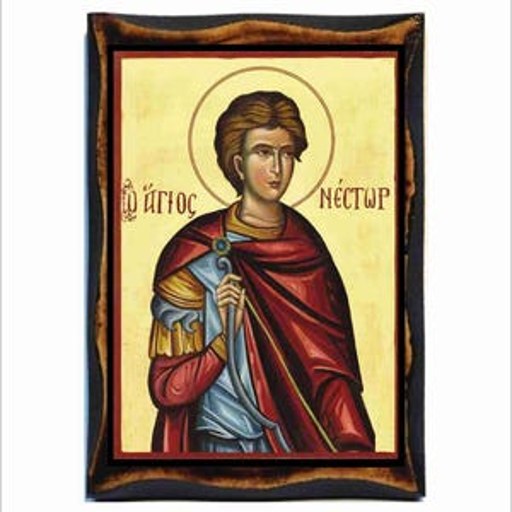
https://www.etsy.com/market/saint_nestor
License: unknown
Nestor
Saint- Feast Day
- 27 October
- Gender
- male
- Church
- Catholic
Places
Roles & Family
Religious Information
Biography
Nestor, commonly called Nestor the Chronicler or Nestor of the Caves, was a monk and writer of Kievan Rus' who lived in the late eleventh and early twelfth centuries and belonged to the Kiev Caves Monastery, the Pechersk Lavra, at Kiev. Reliable contemporary evidence for his biography is extremely thin. His own writings do not supply a birthplace, parentage, or exact dates. Later monastic tradition held that he entered the Caves community at the age of seventeen while Saint Theodosius was still abbot, which would place his birth in the middle of the eleventh century if that notice is accurate, and that he died in the monastery in the second decade of the twelfth century. He is not known to have held episcopal office. His adult life was that of a coenobitic monk devoted to liturgical service and to the composition of sacred biography and, according to later attribution, annals.
Two works of hagiography can be connected with him on reasonably firm literary grounds. The Reading on the Life and Murder of the Blessed Passion-Bearers Boris and Gleb recounts the killing of the sons of Vladimir of Kiev in the succession crisis of the early eleventh century and interprets their deaths as a willing imitation of Christ and a foundation for the Christian identity of the Rus' land. The Life of Theodosius of the Caves, written after Theodosius's death in 1074 and drawing on the memories of monks who had known the abbot, describes the origins of the Caves monastery, Theodosius's ascetic formation, his governance of the community, and his dealings with the princes of Kiev. It remains a principal source for the early history of East Slavic monasticism. Both texts show a writer concerned with edification, with the collection of testimony, and with situating local holy men within a wider Christian past.
From the later Middle Ages Nestor's name was attached to the Primary Chronicle, the Povest' vremennykh let or Tale of Bygone Years, which traces the history of the East Slavs from biblical and legendary beginnings through the conversion under Vladimir and down to the early twelfth century. A manuscript tradition and the Kiev Caves Paterikon present him as the chronicler. Modern philological study has demonstrated that the Chronicle is a composite work with several strata, including earlier Kievan compilations of the late eleventh century, and that it was revised after 1113, notably in a recension associated with the Vydubychi monastery under Sylvester. Scholars therefore differ on whether Nestor authored a full recension, contributed particular narratives such as the Caves material, or was simply the most famous literary name onto which the whole compilation was later projected. The question cannot be settled from the surviving manuscripts alone. Even so, the Chronicle, whatever the exact share of Nestor in it, became the foundational narrative of Rus' history and was copied and continued for centuries.
Nestor is honoured as a saint in the Eastern Orthodox Churches. His principal feast falls on 27 October, and he is also remembered with the other fathers whose relics lie in the Near Caves of the Lavra. Relics ascribed to him are shown in those caves at Kiev. He was a monk, not a patriarch or a pope of Rome or Alexandria, and the sources give no spouse or children. Several other early Christian figures named Nestor, including a martyr of Thessalonica linked in legend with Saint Demetrius and a bishop-martyr of Magydos in Pamphylia, are distinct persons of the Roman imperial period and should not be conflated with the Kievan writer. On the evidence that can be checked, Nestor of the Caves stands as one of the earliest named authors of Kievan Rus' and as a central, if partly shadowed, figure in the making of East Slavic hagiography and historical memory.