Nestor is a saint of the Catholic Church.
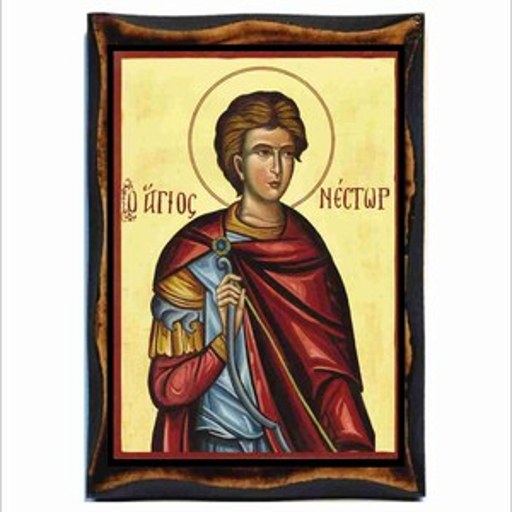
https://www.etsy.com/market/saint_nestor
License: unknown
Nestor
Saint- Gender
- male
- Church
- Catholic
Roles & Family
Biography
The personal name Nestor, of Greek origin, appears repeatedly in Christian hagiography from the Roman imperial period through the Middle Ages. Because the present subject is identified only by that name, with no accompanying place, feast, or other unique identifier, a single biographical record cannot be established from reliable sources. Several distinct holy men and one important medieval writer share the name; their lives, dates, and cults must not be conflated.
The best-known martyr is Nestor of Thessalonica. The Greek passio connected with Saint Demetrius of Thessalonica presents Nestor as a young Christian of that city during the reign of the emperor Maximian in the early fourth century. When Demetrius had been imprisoned for his faith, Nestor visited him in his cell and asked a blessing to confront Lyaeus, a formidable gladiator whom the emperor used to destroy Christians in public spectacle. Strengthened by Demetrius's prayer and making the sign of the cross, Nestor defeated and killed Lyaeus in the stadium. Enraged, Maximian had Nestor beheaded; Demetrius himself was soon after run through with spears. These events are located in Thessalonica. Later liturgical and synaxarial texts commonly assign the martyrdom to 306, but that year is a conventional dating of the Great Persecution rather than a documentarily fixed date. Nestor's feast in the Byzantine rite falls on 27 October. No contemporary source records his parents, a birthplace distinct from the city of his martyrdom, or a burial site that can be verified independently of later tradition. He is not known to have held episcopal, patriarchal, or papal office.
A second early martyr, Nestor of Magydos, sometimes associated with Perge in Pamphylia, is described in his acts as a bishop who was arrested during the Decian persecution around the middle of the third century. After interrogation and refusal to sacrifice he was put to death. His cult is attested in Eastern calendars, with commemorations on or near 28 February, but the acts are late and do not supply a birth year, family details, or a securely identified tomb.
In Kievan Rus the monk Nestor of the Caves, often called Nestor the Chronicler, lived in the late eleventh and early twelfth centuries at the Monastery of the Caves in Kiev. Tradition credits him with compiling the Primary Chronicle, the foundational narrative of the early East Slavic lands, and with composing hagiographical accounts of the passion-bearers Boris and Gleb and of Saint Theodosius, abbot of the Caves. Scholarly opinion continues to discuss how much of the chronicle as it now stands is his personal work, yet his reputation as both historian and hagiographer is firmly established in Slavic ecclesiastical memory. Conventional dates place his birth in the mid-eleventh century and his death around 1113 or 1114; these figures are estimates, not documented vital records. He was a monastic, not a secular cleric of episcopal rank. The Orthodox Church venerates him as a saint, often on 27 October, the same calendar date as the Thessalonian martyr, which has sometimes caused confusion between the two commemorations.
Still other Nestors, including monks, confessors, and local martyrs, appear in menologia of the Greek, Slavic, and Georgian churches. None of them can be shown to have been Bishop of Rome or a patriarch of an autocephalous see. In the absence of a unique identifier, fields that demand a single verified year of birth, a precise birth or death city, a burial place, a spouse, children, a religious order in the Western canonical sense, a single feast day, or a list of patronages must remain empty. What can be stated with confidence is that the name belongs to male figures in the Christian tradition, that none held the papacy or a patriarchate, and that the most influential literary Nestor was a Kievan monk rather than a Roman-era bishop.