Nestor of Magydos is a saint of the Pre-Schism (Universal) Church (d. 251). Nestor of Magydos's feast day is celebrated on 25 February.
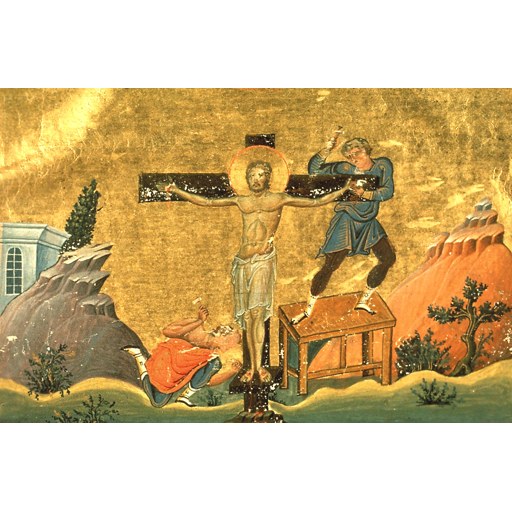
Authors of Menologion of Basil II (circa 985 AC, Constantinople), Byzantine manuscript illuminators[1]: Pantoleon with Georgios, Michael the Younger, Michael of Blachernae, Symeon, Symeon of Blachernae, Menas, and Nestor (Online on Vatican site)
License: Public domain
Nestor of Magydos
Saint- Life Span
- d. 251
- Feast Day
- 25 February
- Gender
- male
- Church
- Pre-Schism (Universal)
Places
Roles & Family
Biography
Saint Nestor of Magydos (also called Nestor of Magidus or Magydus) was a third-century bishop of Magydos, a coastal city in the Roman province of Pamphylia in Asia Minor, in the region of present-day southern Turkey near Antalya. He is venerated in both East and West as a hieromartyr, that is, a bishop who died for the Christian faith. No reliable evidence survives concerning the date or place of his birth, his family, his education, or the circumstances under which he became bishop. What later churches preserved about him is almost exclusively the story of his arrest and death during the persecution initiated by the emperor Decius. Magydos itself was a lesser Pamphylian city compared with Perge, Side, and Attaleia, and Nestor’s see is accordingly obscure outside the martyrological tradition.
Decius, who ruled from 249 to 251, issued an edict that required the inhabitants of the empire to sacrifice to the traditional Roman gods and to obtain a written certificate of compliance. The measure produced the first coordinated, empire-wide persecution of Christians. According to the notice in the Roman Martyrology, Nestor, when the danger became known, devoted himself to prayer night and day for the preservation of his flock. He was subsequently arrested and brought before the provincial authorities. He refused to offer sacrifice and made a public confession of faith in Christ. Condemned as a Christian, he was put to death by crucifixion. Greek liturgical sources sometimes locate the trial or the execution at Perge (Perga), the chief city of Pamphylia, rather than at Magydos; the Latin martyrological tradition places the martyrdom at Magydos itself. The names of officials, the wording of interrogations, and other narrative embellishments found in later recensions cannot be verified and should not be treated as historical fact. No authentic contemporary court record or passion of undisputed early date has survived.
The death is assigned by convention to about 251, at the close of Decius’s reign, though no independent chronicle or inscription confirms the exact year. Nestor’s cult is of the ancient, pre-congregational type: he was commemorated as a martyr by local and then by wider churches without a formal process of canonization of the kind later used by the papacy. The Roman Martyrology lists him on 25 February. In the Byzantine tradition he is numbered among the saints of late February, frequently on 28 February. He is distinct from other early saints named Nestor, notably Nestor of Thessalonica, the companion of Saint Demetrius; the bishop of Magydos is defined by his Pamphylian see and by the Decian dating of his death.
Nothing certain is known of his burial, of any early martyrium at Magydos or Perge, or of later translations of relics. He has not acquired a well-documented list of special patronages of places, professions, or causes in either the Western or the Eastern calendars. Pamphylia in the mid-third century was a Hellenized coastal province with an established Christian presence that had already produced other martyrs in earlier local persecutions. Modern historical study treats the outline—bishop of Magydos, martyr under Decius, death by crucifixion—as the stable core of the tradition, while regarding speeches and picturesque details in later recensions as unhistorical expansions. His significance lies in the witness of a provincial bishop during the Decian crisis and in the continuity of his liturgical commemoration from late antiquity.