Nicetas is a saint of the Catholic Church. Nicetas's feast day is celebrated on 15 September.
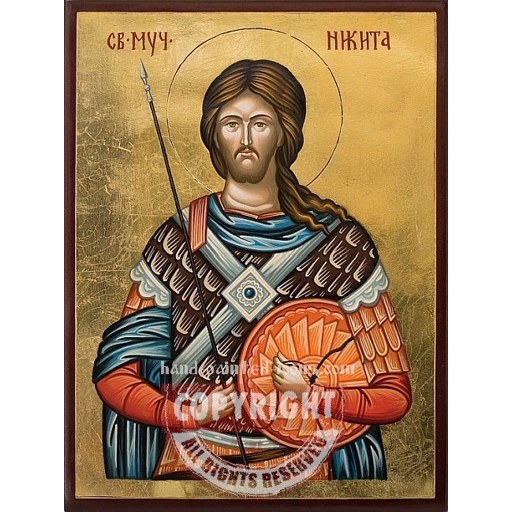
https://hand-painted-icons.com/category/saints-and-angels/saint-nicetas-the-goth/
License: unknown
Nicetas
Saint- Feast Day
- 15 September
- Gender
- male
- Church
- Catholic
Roles & Family
Biography
The name Nicetas (Greek Niketas; Slavic Nikita) was borne by several Christian saints and churchmen, and no Wikidata identifier or encyclopedia article was supplied to fix a single biography. In Eastern hagiography the figure most often meant by the name alone is Nicetas the Goth, a fourth-century martyr among Gothic Christians living north of the Danube. Other historically distinct persons include Nicetas of Remesiana, a bishop in Dacia Mediterranea in the late fourth and early fifth centuries and a correspondent of Paulinus of Nola; Nicetas of Medikion, an abbot in Bithynia who suffered as a confessor in the second iconoclastic period and died in the ninth century; and later Byzantine and Slavic bishops and monks of the same name. The account below therefore concentrates on Nicetas the Goth, whose cult is the earliest and most widespread under this dedication, while remaining explicit that even for him almost all personal detail depends on later Greek passiones rather than on contemporary records.
Christianity had already reached groups of Goths in the third and fourth centuries. A Gothic bishop named Theophilus is listed among those present at the First Council of Nicaea in 325, and the missionary Ulfilas later produced a Gothic version of the Scriptures. The Greek martyrdom narrative presents Nicetas as a convert and disciple of Theophilus and as a teacher of the faith among his own people. In the later 360s and 370s the Gothic ruler Athanaric carried out a persecution of Christians in his territories. That persecution is independently described by the church historians Socrates Scholasticus and Sozomen and is reflected in the fragmentary Gothic liturgical calendar. Within that setting the hagiographical tradition holds that Nicetas refused to abandon Christianity and was put to death by burning. Ancient and medieval sources do not agree on a single civil year; dates in the 370s are conventionally given, but a precise year of birth is unknown and a precise year of death is not securely established.
A Christian companion named Marianus is said to have recovered the martyr’s body and, after a period of concealment, to have brought the relics to Mopsuestia in Cilicia, where a shrine and local cult were established. From Cilicia veneration spread through the Byzantine church. Relics attributed to Nicetas were later reported in Constantinople, and in the medieval Slavic world the saint received important dedications, among them a monastery near Skopje. Because these translations rest on hagiographical narrative, the original place of burial in Gothic territory cannot be verified, nor can a modern city or country of death be named with confidence.
In the Eastern Orthodox Church and in churches that follow the Byzantine rite, the feast of Nicetas the Goth is kept on 15 September; the name also entered some Western martyrologies on that date. Byzantine and Russian icons often show him as a warrior-martyr, a conventional artistic type rather than a documented military career. No contemporary evidence establishes his family, marital status, children, or whether he was ordained. He held neither the papacy nor a patriarchal see and is not associated with a later religious order. Formal Latin processes of beatification or canonization do not apply; his cult is of the ancient, pre-congregational kind. Calendars must be read with care so that this martyr is not confused with Nicetas of Remesiana (commonly 22 June) or Nicetas of Medikion (commonly 3 April).