Nicholas I is a saint of the Catholic Church (d. 867). Nicholas I's feast day is celebrated on 13 November.
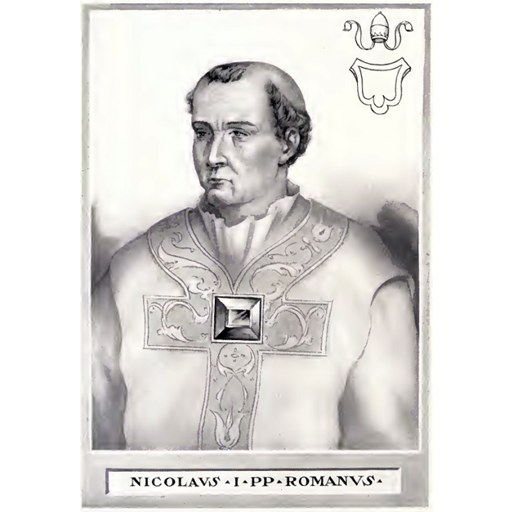
Artaud de Montor (1772–1849)
License: Public domain
Nicholas I
Saint- Life Span
- d. 867
- Feast Day
- 13 November
- Gender
- male
- Church
- Catholic
Places
Relics & Where to Venerate
Location unknown
The bodily remains of Nicholas I are a first-class relic. Venerated at St. Peter's Basilica.
Roles & Family
Biography
Nicholas I, known to later ages as Saint Nicholas the Great, served as bishop of Rome from 858 until 867 and is remembered as one of the strongest architects of medieval papal supremacy. He was born in Rome in the early ninth century into a family of the city’s clerical aristocracy; his father Theodore held the office of defensor ecclesiae. Nothing certain is recorded of his exact year of birth. He received a thorough education in Scripture and canon law and entered the service of the Roman church while still young. Pope Sergius II ordained him subdeacon, and Pope Leo IV raised him to the diaconate. Under Pope Benedict III he became an influential adviser, noted for learning, personal austerity, and administrative energy. When Benedict died, the Roman clergy and people elected Nicholas on 24 April 858. The emperor Louis II, then in the vicinity of Rome, was present at the election and confirmed it; Nicholas was consecrated immediately thereafter.
Nicholas’s pontificate was dominated by a consistent claim that the successor of Peter was the ordinary judge of all bishops and that no metropolitan or royal synod could issue a final sentence without Roman confirmation. That claim was tested most dramatically in the marital cause of King Lothair II of Lotharingia. Lothair, seeking an heir and attached to his concubine Waldrada, attempted to discard his wife Theutberga on charges of incest and sterility. Frankish synods at Aachen and, in 863, at Metz—attended by papal legates who later fell under suspicion of corruption—declared the marriage dissolved. Nicholas quashed the acts of Metz, deposed Archbishops Gunther of Cologne and Theutgaud of Trier, and insisted that Theutberga remain Lothair’s lawful wife. He never yielded, and the king remained without a recognized second marriage at the time of the pope’s death. In a parallel struggle within the Frankish church, Archbishop Hincmar of Reims deposed Bishop Rothad of Soissons. Rothad appealed to Rome; after examining the case Nicholas restored him in 865, thereby vindicating the right of bishops to have recourse to the apostolic see against their metropolitans. These decisions, together with a high Petrine theology expressed in his letters, contributed to the later medieval understanding of papal monarchy, even though some of the canonical texts circulating in his day (the Pseudo-Isidorian collection) would eventually be recognized as ninth-century forgeries.
The most celebrated Eastern controversy of the reign was the Photian Schism. In 858 the Byzantine emperor Michael III and his uncle Bardas removed Patriarch Ignatius and appointed Photius, a distinguished scholar still in lay communion, who was rushed through holy orders. Nicholas, informed by Ignatius’s supporters, refused to acknowledge Photius. Papal legates sent to Constantinople in 861 were induced to recognize the new patriarch at a local synod; Nicholas disavowed them. A Roman synod in 863 declared Photius deposed and Ignatius the legitimate patriarch. Photius answered with a council at Constantinople in 867 that anathematized Nicholas, but the sentence had little effect: later that year Basil I murdered Michael III, Photius was expelled, and Ignatius was restored—developments that occurred around and just after Nicholas’s death. The conflict revealed both the pope’s unwillingness to accept imperial control of the Constantinopolitan see and the growing estrangement between Latin and Greek Christianity.
Nicholas also tried to bring the newly Christian kingdom of Bulgaria into the Roman orbit. Khan Boris I, baptized in 864 under Byzantine auspices, soon sought a more independent ecclesiastical arrangement and turned to Rome with a long questionnaire on Christian belief, ritual, and social discipline. In November 866 Nicholas issued the Responsa ad consulta Bulgarorum, a pastoral letter of exceptional detail that mixed doctrinal instruction with practical rulings on marriage, fasting, criminal law, and the remnants of pagan custom. He dispatched Latin bishops, including Formosus of Porto, and hoped to erect a Bulgarian church dependent on Rome rather than on Constantinople. After his death the project failed; at the Council of Constantinople in 869–870 Bulgaria was assigned to the Eastern patriarchate. Nicholas died in Rome on 13 November 867 and was buried in St. Peter’s Basilica. He was venerated as a saint from an early date, and his feast is observed on 13 November. Medieval and modern writers have numbered him with Leo I and Gregory I among the popes called “the Great,” a title reflecting the lasting consequences of his defense of Roman primacy against kings, metropolitans, and the imperial church of Constantinople.