Nicholas is a saint of the Catholic Church.
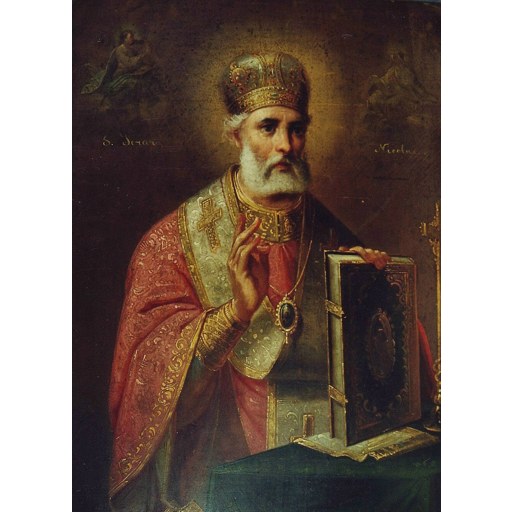
Gheorghe Tattarescu
License: Public domain
Nicholas
Saint- Gender
- male
- Church
- Catholic
Places
Relics & Where to Venerate
Housed at All Saints church · Czech Republic
Nicholas Serbian Orthodox Church Gift from Bari, Italy, September 25, 2013 Livonia, Michigan: All Saints Shrine, Sacred Heart Byzantine Catholic Church Four relics, including from the radius arm bone Morton Grove, Illinois: Shrine of All saints, St
Housed at San Nicola · Italy
Saint Nicholas' primary relics are located in a tomb in the crypt of the Basilica di San Nicola, Bari, Italy, where they have rested since 1087
Location unknown
Nicholas Serbian Orthodox Church Gift from Bari, Italy, September 25, 2013 Livonia, Michigan: All Saints Shrine, Sacred Heart Byzantine Catholic Church Four relics, including from the radius arm bone Morton Grove, Illinois: Shrine of All saints, St
Location unknown
Nicholas Serbian Orthodox Church Gift from Bari, Italy, September 25, 2013 Livonia, Michigan: All Saints Shrine, Sacred Heart Byzantine Catholic Church Four relics, including from the radius arm bone Morton Grove, Illinois: Shrine of All saints, St
Location unknown
Nicholas The monastery has many holy relics Ano Vatheia, Evia: St Nicholas Monastery Apikia, Andros; Saint Nicholas Monastery Kalavryta: Monastery of Agia Lavra Portaria, Thessaly: Church of Agios Nikolaos Salamina: Holy Monastery of Faneromeni Volos: Metropolitan Church (Greek Orthodox) Left arm fragment Germany Brauweiler: Abteikirche Ss
Location unknown
Nicholas Serbian Orthodox Church Gift from Bari, Italy, September 25, 2013 Livonia, Michigan: All Saints Shrine, Sacred Heart Byzantine Catholic Church Four relics, including from the radius arm bone Morton Grove, Illinois: Shrine of All saints, St
Location unknown
Nicholas The monastery has many holy relics Ano Vatheia, Evia: St Nicholas Monastery Apikia, Andros; Saint Nicholas Monastery Kalavryta: Monastery of Agia Lavra Portaria, Thessaly: Church of Agios Nikolaos Salamina: Holy Monastery of Faneromeni Volos: Metropolitan Church (Greek Orthodox) Left arm fragment Germany Brauweiler: Abteikirche Ss
Housed at Metropolitan Cathedral · Iași, Romania
Nicholas The monastery has many holy relics Ano Vatheia, Evia: St Nicholas Monastery Apikia, Andros; Saint Nicholas Monastery Kalavryta: Monastery of Agia Lavra Portaria, Thessaly: Church of Agios Nikolaos Salamina: Holy Monastery of Faneromeni Volos: Metropolitan Church (Greek Orthodox) Left arm fragment Germany Brauweiler: Abteikirche Ss
Location unknown
Nicholas The monastery has many holy relics Ano Vatheia, Evia: St Nicholas Monastery Apikia, Andros; Saint Nicholas Monastery Kalavryta: Monastery of Agia Lavra Portaria, Thessaly: Church of Agios Nikolaos Salamina: Holy Monastery of Faneromeni Volos: Metropolitan Church (Greek Orthodox) Left arm fragment Germany Brauweiler: Abteikirche Ss
Location unknown
Nicholas Serbian Orthodox Church Gift from Bari, Italy, September 25, 2013 Livonia, Michigan: All Saints Shrine, Sacred Heart Byzantine Catholic Church Four relics, including from the radius arm bone Morton Grove, Illinois: Shrine of All saints, St
Housed at Basilica of Saint Nicholas · Italy
Nicholas The monastery has many holy relics Ano Vatheia, Evia: St Nicholas Monastery Apikia, Andros; Saint Nicholas Monastery Kalavryta: Monastery of Agia Lavra Portaria, Thessaly: Church of Agios Nikolaos Salamina: Holy Monastery of Faneromeni Volos: Metropolitan Church (Greek Orthodox) Left arm fragment Germany Brauweiler: Abteikirche Ss
Location unknown
Nicholas Serbian Orthodox Church Gift from Bari, Italy, September 25, 2013 Livonia, Michigan: All Saints Shrine, Sacred Heart Byzantine Catholic Church Four relics, including from the radius arm bone Morton Grove, Illinois: Shrine of All saints, St
Biography
The name Nicholas (from Greek Nikolaos, “victory of the people”) has been borne by a great many Christian hierarchs, monks, and lay devotees across late antiquity, the Middle Ages, and later centuries. Wikidata item Q2396437 is identified only as “Nicholas,” with no Wikipedia article supplied and no epithet, see, or distinctive date attached. In hagiographical practice this immediately requires caution. The Bollandists’ Acta Sanctorum and the Bibliotheca Hagiographica Latina and Graeca record vitae and cults for numerous distinct saints of this name: the fourth-century bishop of Myra in Lycia, the sixth-century abbot of Sion, the eleventh-century pilgrim of Trani, the thirteenth-century Augustinian of Tolentino, the fifteenth-century Swiss hermit of Flüe, several Franciscan and Dominican martyrs, and later missionaries such as Nicholas of Japan. Each of those figures is already catalogued under a different Wikidata identifier. The present item therefore cannot be equated with any of them on the information given.
No reliable historical or liturgical source consulted for this notice attaches a birth year, death year, or even a secure century to Q2396437. Standard method forbids inserting the year a man took episcopal or abbatial office in place of a natal year, and still more forbids borrowing the chronology of a better-known namesake. Places of birth, death, and burial are likewise unattested. Statements that a given Nicholas was born at Patara, died at Myra, or was translated to Bari belong exclusively to the Lycian bishop and must not be transferred. The same restraint applies to claims of monastic profession, marriage, or offspring: some historical Nicholases were monks of Benedictine, Augustinian, Franciscan, or Basilian observance; others were secular clergy or laymen. None of these states of life can be documented for this specific record.
Whether the individual ever occupied the see of Rome or an Eastern patriarchate (Constantinople, Alexandria, Antioch, or a catholicosate of the Church of the East or an Oriental Orthodox church) is equally unknown. The popes numbered Nicholas I through V and the various Orthodox patriarchs named Nicholas are already identified under other items. No feast day, list of patronages, or act of beatification or canonization can be verified for Q2396437. The enormous range of popular patronages associated with “Saint Nicholas”—sailors, children, pawnbrokers, Amsterdam, Russia, and many others—attaches to particular, well-documented figures, principally Nicholas of Myra, and cannot be listed here without creating precisely the confusion this notice seeks to avoid.
In short, Q2396437 remains an insufficiently documented individual named Nicholas. Responsible historical and hagiographical practice therefore leaves every specific biographical field blank rather than risk substituting data that belong to another person of the same name. Further identification would require direct examination of the Wikidata entry itself, its referenced sources, or local martyrologies and diocesan records that have not been supplied.