Nicodemus is a saint of the Catholic Church. Nicodemus's feast day is celebrated on 3 August.
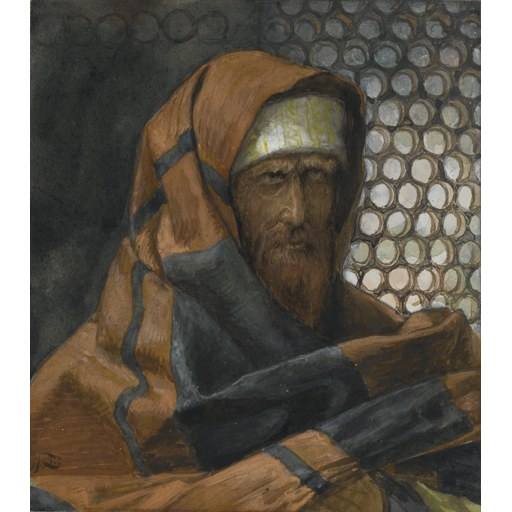
James Tissot
License: Public domain
Nicodemus
Saint- Feast Day
- 3 August
- Gender
- male
- Church
- Catholic
Places
Roles & Family
Biography
Nicodemus appears in the New Testament solely in the Gospel of John, where he is introduced as a Pharisee and a ruler of the Jews. In the setting of first-century Jerusalem that title indicates membership in the Sanhedrin, the council that combined religious and civic authority under Roman rule. The Pharisees were a lay movement devoted to the Law and to oral tradition; a Pharisee on the council would have been a person of learning and standing. John does not give Nicodemus a home town, a genealogy, or dates of birth and death. He is absent from the Gospels of Matthew, Mark, and Luke. His first appearance is the night visit to Jesus, often placed early in Jesus's public activity. Coming by night has been read as fear of other leaders, as a rabbinic custom of nighttime study, or as John's symbolism of moving from darkness toward light. Jesus tells him that seeing the kingdom of God requires being born from above. Nicodemus takes the saying in a physical sense, asking how an old man can be born a second time, and Jesus speaks of birth of water and Spirit, of the wind that blows where it wills, and of the Son of Man who must be lifted up as Moses lifted the serpent in the wilderness so that whoever believes may have eternal life. The evangelist then states that God loved the world and gave the only Son, that believers might not perish.
In John chapter 7, during the Festival of Booths, officers sent to arrest Jesus return empty-handed, and the Pharisees scorn both the crowd and any ruler who might believe. Nicodemus, identified again as one of their number who had come to Jesus earlier, objects that the Law does not judge a person unless it first hears him and knows what he does. The reply is a sneer: is he too from Galilee, and do they search and see that no prophet arises from Galilee. The scene shows him still inside the council, arguing for legal procedure rather than openly confessing discipleship. After the death of Jesus, John describes Joseph of Arimathea as a disciple, though a secret one for fear of the Jews, who asks Pilate for the body. Nicodemus, who at first had come to Jesus by night, comes with him bringing a mixture of myrrh and aloes, about a hundred pounds in weight. They take the body, bind it in linen cloths with the spices as is the burial custom of the Jews, and lay it in a new tomb in a garden at the place of crucifixion, because the Sabbath was beginning. The quantity of spices is extraordinary and has been read as a royal or highly honorific burial and as a sign of Nicodemus's wealth and of a more public loyalty at the end.
Christian imagination did not stop with John. From late antiquity an apocryphal narrative, the Gospel of Nicodemus or Acts of Pilate, circulated under his name; it recounts the trial before Pilate, the descent into Hades, and related legends, and it is a work of pious fiction rather than a report by the historical Nicodemus. Medieval and some modern writers have equated him with Nicodemus ben Gurion, or Naqdimon ben Gurion, a rich Jerusalemite in rabbinic stories who was famed for piety and for miraculous rain; the names match in Greek and Hebrew form, but the identification is not proven. Later Eastern lives say the apostles Peter and John baptized him, that he was struck from the Sanhedrin and forced from the city, and that he died a martyr. Western medieval sources repeat the fifth-century claim of Lucian of Caphargamala that in the year 415 Gamaliel appeared in a dream and revealed a tomb containing Stephen, Nicodemus, Gamaliel himself, and Abibas. Relics associated with that story were venerated in Jerusalem and later in the West. None of these expansions can be confirmed by first-century evidence.
The churches came to honor Nicodemus as a saint. The Roman Martyrology lists him on 3 August in connection with the reported finding of those relics. Eastern Orthodox calendars remember him on 2 August and, together with those who cared for the body of Christ, on the Sunday of the Myrrh-bearing Women. He was never a pope or a patriarch, and no reliable source records a wife, children, monastic profession, or a precise place of birth or death. Hagiography therefore rests on the three Johannine episodes: a teacher of Israel who comes by night and hears of new birth; a councillor who insists on a hearing according to the Law; and a man who, with Joseph of Arimathea, gives Jesus a burial of costly spices. In that limited but vivid portrait later devotion has seen a model of the seeker, of the secret believer who grows toward public fidelity, and of reverence for the body of Christ.