Nicolas Steno is a blessed of the Catholic Church (1638 - 1686). Nicolas Steno's feast day is celebrated on 5 December.
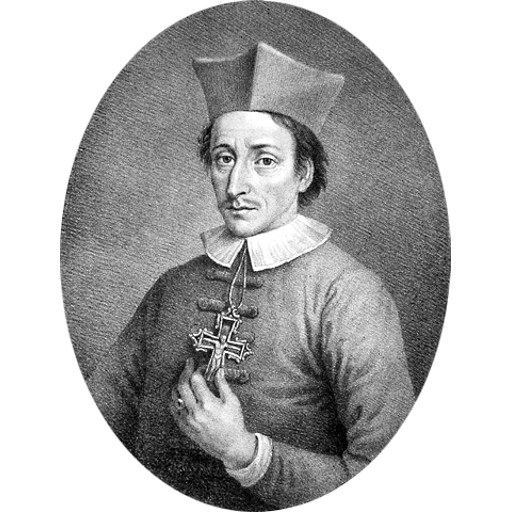
Niels_stensen.jpg: J. P. Trap 1868 derivative work: nagualdesign (talk)
License: Public domain
Nicolas Steno
Blessed- Life Span
- 1638 - 1686 (age 48)
- Feast Day
- 5 December
- Gender
- male
- Church
- Catholic
Places
Relics & Where to Venerate
Location unknown
The bodily remains of Nicolas Steno are a first-class relic. Venerated at Basilica of San Lorenzo.
Roles & Family
Canonization
Biography
Nicolas Steno (born Niels Stensen; Latin Nicolaus Stenonis) was a Danish anatomist, geologist, and Catholic bishop whose scientific work in the seventeenth century laid foundations for stratigraphy, paleontology, and crystallography. He was born in Copenhagen on 11 January 1638 into a Lutheran family; his father, Sten Pedersen, was a goldsmith who worked for the Danish court. After early schooling in Copenhagen he studied medicine at the University of Copenhagen from the mid-1650s and then continued his training in the Netherlands, at Amsterdam and at the University of Leiden. There he made lasting anatomical discoveries, including the parotid duct (still called Stensen’s duct), and published studies showing that the heart is a muscle, that skeletal muscle is composed of fibers, and that glands and the lymphatic system could be investigated by careful dissection and experiment.
In 1666 Steno entered the service of the Medici court in Florence. Dissection of a great white shark’s head led him to identify the so-called glossopetrae of Tuscan rocks as fossilized shark teeth, an observation that supported the view that fossils are remains of once-living organisms rather than sports of nature. Fieldwork in Tuscany produced his 1669 Prodromus (De solido intra solidum naturaliter contento dissertationis prodromus), in which he stated the principles of superposition, original horizontality, and lateral continuity of strata, and distinguished marine from terrestrial deposits. The same work contained the law of constancy of interfacial angles in crystals. These contributions established him as a founder of modern geology even though he soon left research for the Church.
Received into the Catholic Church on 2 November 1667, Steno was ordained a priest in Florence in 1675. In 1677 Pope Innocent XI named him apostolic vicar of the Nordic Missions and titular bishop of Titiopolis; he was consecrated in Rome that September. He thereafter lived in poverty in northern Germany—Hanover, Münster, Hamburg, and finally Schwerin—serving scattered Catholic communities in Lutheran territories, practicing severe personal austerity, and giving away what little he possessed. He did not belong to a religious order; he was a secular priest raised to the episcopate.
Steno died in Schwerin on 25 November 1686 at the age of forty-eight. At the request of Cosimo III de’ Medici his body was taken to Florence and buried in the Basilica of San Lorenzo, where his remains remain. He was beatified by Pope John Paul II on 23 October 1988. Although he abandoned scientific publication after ordination, his earlier anatomical and geological writings continue to be regarded as foundational, and he is commemorated in the Catholic Church on 5 December.