Nicolò Rusca is a blessed of the Catholic Church (1563 - 1618). Nicolò Rusca's feast day is celebrated on 4 July.
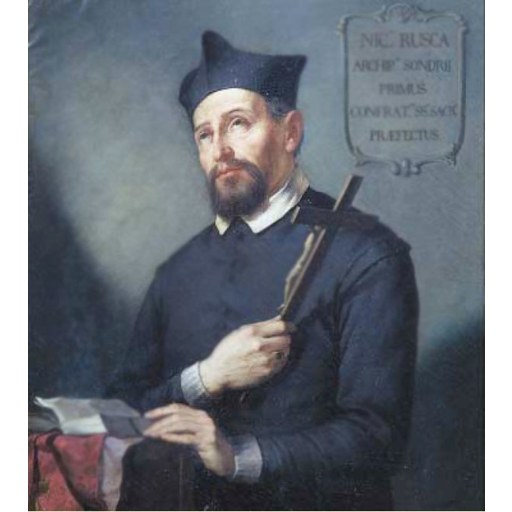
en:Antonio Caimi´(1814–1878)
License: Public domain
Nicolò Rusca
Blessed- Life Span
- 1563 - 1618 (age 55)
- Feast Day
- 4 July
- Gender
- male
- Church
- Catholic
Places
Relics & Where to Venerate
Location unknown
The bodily remains of Nicolò Rusca are a first-class relic. Venerated at Santi Gervasio e Protasio.
Roles & Family
Canonization
Biography
Nicolò Rusca was born on 20 April 1563 in Bedano, in the Italian-speaking bailiwick of Lugano, then under the Old Swiss Confederacy and today in the canton of Ticino. He belonged to the Rusca family, which had long-standing ties to the Como–Ticino region. Formed for the priesthood in the climate of the Catholic reform, he received a humanist and theological education that included studies associated with the Jesuit college in Milan, a principal centre of Tridentine renewal in Lombardy. He was ordained a priest in 1587 for the Diocese of Como, whose territory in that period extended over parts of present-day Ticino, the Valtellina, and neighbouring Alpine lands as well as the city of Como itself.
From 1591 he served as archpriest of Sondrio, the chief town of the Valtellina. The valley was largely Catholic in population but politically subject to the Three Leagues of the Grisons, where Reformed Protestantism was strong among the ruling communes. Rusca’s long pastorate therefore unfolded on a confessional frontier. He worked to strengthen Catholic preaching, catechesis, and the instruction of youth, and to uphold clerical discipline in his parish. Catholic contemporaries regarded him as a learned, charitable, and determined pastor. Protestant officials and preachers regarded him as a serious obstacle to Reformed expansion and as a figure aligned with Catholic powers, above all Spanish Milan, for which the Valtellina was a strategic corridor between Italy and the Empire.
In 1618 political and religious conflict in the Grisons came to a head. A special criminal court of the Protestant party sat at Thusis. Rusca was seized in Sondrio, taken over the Alpine passes, and interrogated under torture. He died in Thusis on 4 July 1618 from the effects of that treatment, at the age of fifty-five. Catholics immediately honoured him as a martyr who had suffered for his priesthood and had refused to abandon the Catholic faith or to confess political crimes under duress. His death belonged to the chain of events that led, two years later, to the Catholic rising in the Valtellina and the killings of 1620 known as the Sacro Macello, and to the subsequent Valtellina war in the opening phase of the Thirty Years’ War.
A local cult persisted in the Valtellina and the Diocese of Como. Remains associated with him were later venerated in Sondrio, where he had been archpriest. The modern cause treated him as a martyr killed in odium fidei. Pope Benedict XVI authorized the decree on his martyrdom in December 2011, and he was beatified on 21 April 2013 at a ceremony in Sondrio during the pontificate of Pope Francis, with Cardinal Angelo Amato presiding as papal legate. His liturgical memorial is kept on 4 July, the anniversary of his death. He remains a central figure in the religious memory of the Valtellina as a diocesan priest of the Counter-Reformation who died in the Alpine confessional struggles of the early seventeenth century.