Nicostratus is a saint of the Catholic Church. Nicostratus's feast day is celebrated on 8 November. Nicostratus is the patron saint of stonemasons;sculptors.
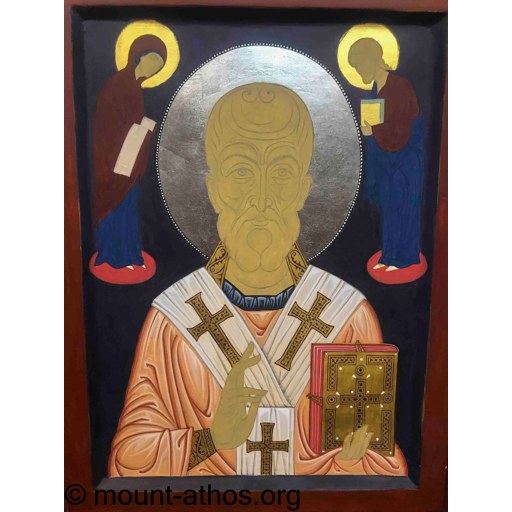
https://mount-athos.org/en/my-icons/nicholas
License: unknown
Nicostratus
Saint- Feast Day
- 8 November
- Gender
- male
- Church
- Catholic
Roles & Family
Patronage
stonemasons;sculptors
Biography
Nicostratus is the name attached to one of the early Christian martyrs commemorated in the Roman tradition as the Four Crowned Martyrs (Quattuor Coronati). Almost nothing about his life can be established from contemporary historical evidence. The surviving accounts are late hagiographical legends, and modern scholarship generally holds that at least two different groups of martyrs were fused in the medieval cult: a set of Christian stonemasons or sculptors associated with Pannonia, and a set of Roman martyrs whose original names were not preserved. The names Claudius, Nicostratus, Symphorianus (also given as Sempronianus or Simpronian), Castorius, and often a fifth companion, Simplicius, became fixed in the Roman Martyrology and in the dedication of the basilica of Santi Quattro Coronati on the Caelian Hill in Rome. The cult itself is historically real by the fourth or fifth century; the personal biography is not.
In the legendary Passio of the Pannonian artisans, Nicostratus and his companions are described as skilled Christian sculptors employed on imperial building works. They are said to have refused an order to carve a statue of the pagan healing god Aesculapius, or to offer sacrifice, and to have been interrogated, tortured, and put to death, in some versions by being sealed in lead coffins and cast into a river. The Roman Martyrology places this martyrdom at Rome on the Via Labicana in the time of Diocletian. Independent corroboration of these details does not exist. A Diocletianic setting in the early fourth century is a conventional and plausible background for such a cult, but the narrative follows the stock pattern of late-antique martyr acts and cannot be treated as a reliable record of names, places, or circumstances.
A separate strand of legend, found in the Acts of Saint Sebastian, presents a Nicostratus as a Roman official whose wife Zoe had long been unable to speak. After Zoe was said to have been healed through Sebastian’s prayer, Nicostratus and members of his household converted and were later martyred. Whether this figure is the same person as the sculptor of the Four Crowned group, a distinct martyr whose name was later absorbed into that cult, or a purely literary character cannot be determined from the sources. Medieval calendars settled on 8 November as the feast of Claudius, Nicostratus, Symphorianus, Castorius, and Simplicius. The basilica of the Santi Quattro Coronati, rebuilt in the early Middle Ages and again in the twelfth century, became the principal Roman shrine of the group; a traditional burial or deposition on the Via Labicana is reported in the martyrological tradition but is not archaeologically verified as the grave of a historically identifiable Nicostratus.
As a member of the Four Crowned Martyrs, Nicostratus shares their later medieval patronage of stonemasons, sculptors, and related building crafts, a devotion that spread with masons’ guilds. He is not recorded as a bishop, patriarch, or pope, and no reliable evidence survives for his place or date of birth, his family, or any religious order. Claims of a wife named Zoe belong only to the Sebastian legend and should not be treated as established fact. The historian can affirm the antiquity of the Roman cult and the liturgical feast; the individual life of Nicostratus remains, on present evidence, legendary.