Nikolay Svyatosha is a venerable of the Catholic Church (d. 1143). Nikolay Svyatosha's feast day is celebrated on 14 October.
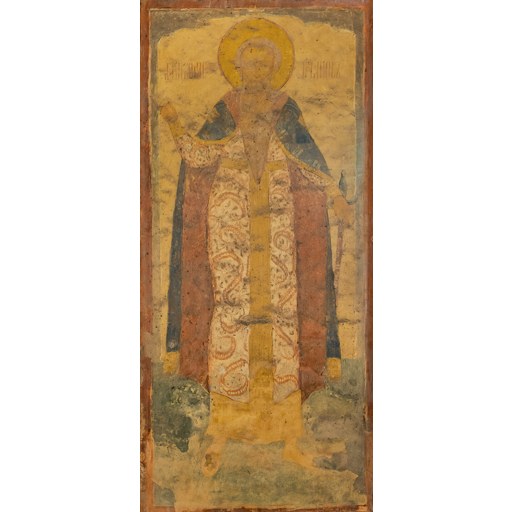
Unknown authorUnknown author
License: CC BY-SA 4.0
Nikolay Svyatosha
Venerable- Life Span
- d. 1143
- Feast Day
- 14 October
- Gender
- male
- Church
- Catholic
Places
Relics & Where to Venerate
Location unknown
The bodily remains of Nikolay Svyatosha are a first-class relic. Venerated at Kyiv Pechersk Lavra.
Roles & Family
Religious Information
Biography
Nikolay Svyatosha (also Nicholas Sviatosha or Nikolai Svyatosha) was a Rurikid prince who became a monk of the Kiev Pechersk Lavra and is venerated as a saint in the Eastern Orthodox Church. In secular life he was Svyatoslav Davidovich, son of David Sviatoslavich, Prince of Chernigov, and grandson of Sviatoslav II Yaroslavich, who had been Grand Prince of Kiev. He belonged to the Chernigov branch of the dynasty that ruled the lands of Rus' in the eleventh and twelfth centuries. Before his tonsure he is recorded as prince of Lutsk. Church tradition styles him a prince of Chernigov because of that paternal house. Medieval writers present him as the first among the princes of Rus' to take monastic vows, an act that struck contemporaries because it set princely rank aside in an age of dynastic war and Cuman campaigning.
According to the Kievan chronicle tradition and the Kievan Caves Paterikon, he received the monastic tonsure at the Caves Monastery in 1106 and was given the name Nicholas. The epithet Svyatosha, already used in medieval sources, marks him as exceptionally devout. He claimed no privilege of birth inside the monastery. The Paterikon relates that he labored in the kitchen, carried water, and chopped wood for the brethren; that he then spent three years as porter at the monastery gate; and that he later tended a garden by his cell. He is described as remaining within the monastic enclosure and as distributing his remaining wealth to the poor and to the house. Those menial obediences, performed by a man who had been a ruling prince, became the center of his reputation for humility. Later synaxaria add that in leaving the world he also left a wife and children, though the earliest chronicle notice records only his princely origin and his taking of vows.
The Paterikon also preserves the story of his physician, a Syrian named Peter, who repeatedly urged him to relax his austerity and who was himself drawn toward conversion and the monastic life by Nicholas's example and foreknowledge. Tradition holds that he lived some thirty-six years in the monastery after his tonsure. He was never a bishop, patriarch, or pope; his sanctity is that of a monastic confessor. After his death the same source relates that his brother Prince Izyaslav Davidovich received the saint's hair-shirt and monastic cap, and that Izyaslav was preserved in battle when he wore these relics and wounded when he laid them aside.
Nicholas Svyatosha died on 14 October 1143 and was buried in the Near Caves associated with Saint Anthony at the Kiev Pechersk Lavra, where his relics have continued to be venerated. His principal feast is 14 October; he is also commemorated in the Synaxis of the Venerable Fathers of the Kiev Near Caves. His cult belongs to the wider medieval and later Orthodox veneration of the Kievan Caves saints in the East Slavic churches. Precise details of his birthplace and of his family life before tonsure are not firmly established in the earliest sources, and no exact year of birth is securely attested.