Nivard is a saint of the Catholic Church (d. 673). Nivard's feast day is celebrated on 1 September.
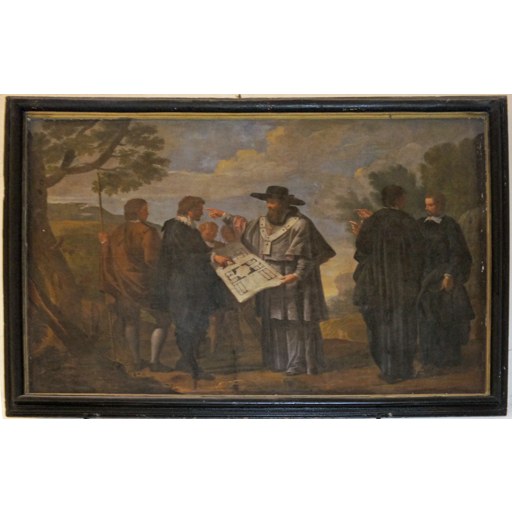
Claude Charles
License: CC BY-SA 3.0
Nivard
Saint- Life Span
- d. 673
- Feast Day
- 1 September
- Gender
- male
- Church
- Catholic
Places
Roles & Family
Canonization
Biography
Nivard, also known as Nivardus or Nivo, was a seventh-century Frankish prelate who served as Archbishop of Reims during the later Merovingian period. He belonged to the Neustrian nobility and is described in later tradition as a kinsman of the Merovingian royal house. Some medieval and early modern accounts present him as a cousin of King Dagobert I, while others associate him with the family of Queen Bilichild, wife of Childeric II. Precise details of his parentage, place of birth, and early life are not preserved in contemporary documents, and the year of his birth is unknown. He appears in the historical record principally through the episcopal lists of Reims and through the foundation history of the monastery of Hautvillers.
Nivard succeeded Landon as archbishop of Reims around the middle of the seventh century, with the beginning of his episcopate commonly placed in 657, though some catalogues give a slightly earlier date. Reims was already one of the principal sees of the Frankish kingdoms, and its archbishops played an important role in the religious and political life of Neustria and Austrasia. During his tenure Nivard is credited with founding the Abbey of Hautvillers (Altum Villare) in the Champagne countryside, traditionally in the early 660s. According to monastic tradition, he established the house with the assistance of Saint Bercharius (Berchaire), who became its first abbot, and he endowed it with lands and privileges. Hautvillers later followed the Benedictine Rule and became a notable centre of monastic life in the diocese.
Nivard died on 1 September, traditionally in the year 673, and was buried at Hautvillers, the monastery he had founded. His tomb became a focus of local veneration, and he was honoured as a saint in the diocese of Reims and in the monastic calendar of Hautvillers. His feast is kept on 1 September. Like many Merovingian bishops, he was recognised as a saint by popular cult and local episcopal approval rather than by a later formal process of canonization at Rome, and he is therefore counted among the pre-Congregation saints. Surviving evidence for his life is limited: there is no extensive contemporary vita, and later medieval notices, including material used by Flodoard of Reims in his history of the church of Reims, mix administrative memory with hagiographical convention. Modern historians therefore treat the outline of his episcopate and the Hautvillers foundation as historically plausible while remaining cautious about legendary elaborations of his royal kinship and personal miracles.
The cult of Saint Nivard remained essentially regional. He is remembered as a founder-bishop of the church in Champagne rather than as a figure of universal devotion, and no extensive list of patronages is securely attached to his name in the major martyrologies. His historical importance lies in the continuity of the see of Reims in the seventh century and in the establishment of Hautvillers, which endured as a Benedictine abbey until the French Revolution. Relics associated with him were preserved at Hautvillers in the Middle Ages. Uncertainties remain about the exact chronology of his birth, the place of his death, and the finer points of his family connections, which later genealogical and hagiographical writers did not always distinguish from pious tradition.