Notker the Stammerer is a blessed of the Catholic Church (d. 912). Notker the Stammerer's feast day is celebrated on 6 April.
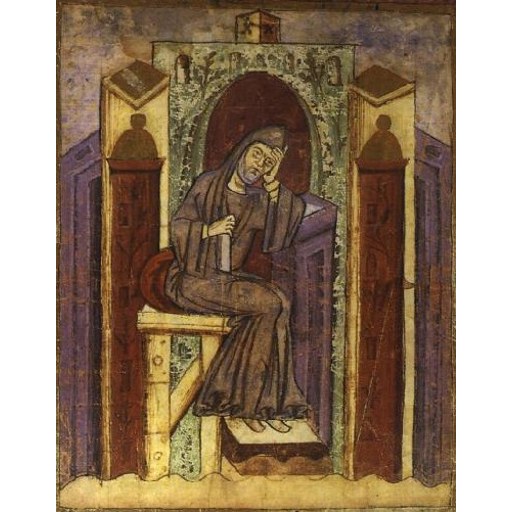
Unknown authorUnknown author
License: Public domain
Notker the Stammerer
Blessed- Life Span
- d. 912
- Feast Day
- 6 April
- Gender
- male
- Church
- Catholic
Places
Roles & Family
Religious Information
Biography
Notker the Stammerer, known in Latin as Notker Balbulus and sometimes distinguished as Notker I of Saint Gall, was a Benedictine monk, teacher, poet, and composer of the Abbey of Saint Gall in Alemannia, in what is now northeastern Switzerland. Later monastic tradition places his birth around the middle of the ninth century in a family of standing in the Thurgau; a number of modern reference works name Jonschwil, on the River Thur south of Wil, as his probable birthplace. In keeping with Carolingian practice for sons of the nobility destined for the Church, he was given as a child oblate to Saint Gall, then one of the foremost Benedictine houses of East Francia and a major centre of learning, book production, and liturgical chant. He spent the whole of his adult life in that community.
The monastic school trained him in grammar, Scripture, and the chant of the Roman rite as it was sung in the Frankish kingdoms. A speech impediment, which contemporaries marked with the nickname Balbulus, did not prevent him from becoming one of the abbey’s most respected masters. Memories of the community written down in the eleventh century by Ekkehard IV in the Casus sancti Galli present Notker as humble, witty, and devout, and they pair him with two other gifted monks of the house, Tuotilo and Ratpert. He is recorded as librarian and as a teacher of younger monks and of external pupils, and as faithful to the daily round of choir and school under the Rule of Saint Benedict.
His principal lasting contribution to Latin liturgy and poetry was his work on the sequence. Building on earlier experiments with adding text to the long melismas of the Alleluia, he composed a cycle of sequences for the feasts of the year, gathered in the Liber hymnorum and dedicated to Liutward of Vercelli, archchaplain of Charles the Fat, probably in the 880s. These accentual, strophic Latin poems helped establish the sequence as a standard part of the Mass across much of medieval Europe. Saint Gall manuscripts preserve the texts and, in some cases, associated melodies. Other writings attributed to him include hymns, a metrical life of Saint Gall, letters, and shorter verse, though the exact limits of his corpus remain in part a matter of philological discussion.
At the request of the emperor Charles the Fat he also wrote the Gesta Karoli Magni, completed in the mid-880s. The work is a collection of anecdotal stories about Charlemagne, many of them legendary or moralizing rather than documentary, intended as a mirror of Christian kingship for a later Carolingian ruler. Though of limited value as a source for the eighth-century emperor himself, the Gesta circulated widely and shaped medieval and later popular images of Charlemagne. Notker died at Saint Gall on 6 April 912 and was buried at the abbey. He was honoured there as a saint and his feast is kept on 6 April; he was never the subject of a formal papal canonization, but his local cult and his sequences preserved his name in Benedictine and liturgical tradition.