Novatus is a saint of the Catholic Church. Novatus's feast day is celebrated on 20 June.
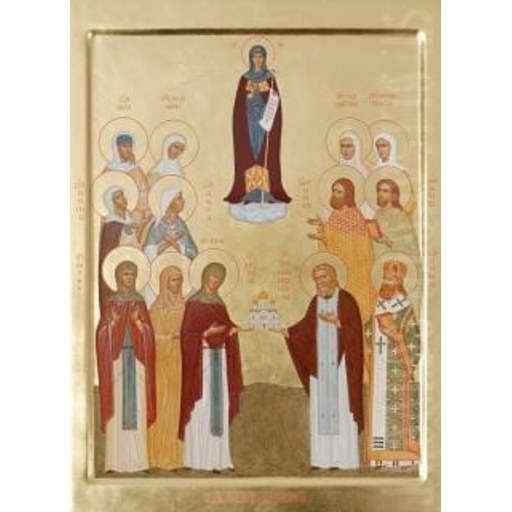
https://catalog.obitel-minsk.com/icons-prav/painted-icons.html
License: unknown
Novatus
Saint- Feast Day
- 20 June
- Gender
- male
- Church
- Catholic
Places
Roles & Family
Biography
Saint Novatus is venerated as an early Christian saint of Rome and is commemorated in the Roman Martyrology on 20 June. According to a tradition that took shape in later antiquity, he belonged to a prominent Roman household: he was the son of the senator Pudens and of Claudia, and the brother of the priest Timothy and of the virgins Saints Pudentiana and Praxedes. The same tradition holds that the family received the Apostles, especially Saint Peter, and that their residence on the Esquiline became the ancient titulus later known as the church of Santa Pudenziana. In these accounts Novatus appears as a devout Christian who used family resources to aid the poor and to support the Roman church.
These particulars come chiefly from the legendary Acts of Saints Pudentiana and Praxedes, texts that modern scholarship generally dates to the fifth or sixth century and does not treat as historically reliable. No contemporary second-century source independently confirms Novatus’s parentage, an apostolic baptism, or any specific deeds. The Roman Martyrology’s notice for 20 June presents him as the son of the blessed senator Pudens and brother of Timothy, Pudentiana, and Praxedes, who were instructed in the faith by the Apostles, and it locates his dies natalis at Rome, but it supplies no year of death. Later hagiographical compilations commonly assign his death to about 151, in the time of Antoninus Pius; that year remains traditional rather than critically verified.
The cult of Novatus was local to Rome and closely tied to the veneration of his purported sisters. Santa Pudenziana and Santa Prassede, both ancient titular churches, preserve the memory of the Pudens family in Roman topography and liturgy. Novatus himself did not become the centre of a widespread patronage or of a major independent shrine. He was neither pope nor patriarch, and there is no evidence that he belonged to any later religious order. Nothing historically certain is known of marriage or children, and he is not documented as the patron of particular places, professions, illnesses, or groups.
A different Novatus, a priest of Carthage in the mid-third century, appears in the correspondence of Saint Cyprian as an opponent of Cyprian’s authority and later as an ally of the Roman rigorist Novatian during the controversy over the lapsed after the Decian persecution. That Carthaginian priest is a historical figure of the 250s, but he is not the saint of 20 June and was not venerated as a saint. The two men have occasionally been confused in older literature; they belong to different centuries and different churches. Beyond the martyrological entry and the legendary family cycle, the life of Saint Novatus of Rome remains obscure.