Nunilo and Alodia is a saint of the Catholic Church (d. 851). Nunilo and Alodia's feast day is celebrated on 22 October. Nunilo and Alodia is the patron saint of Adahuesca.
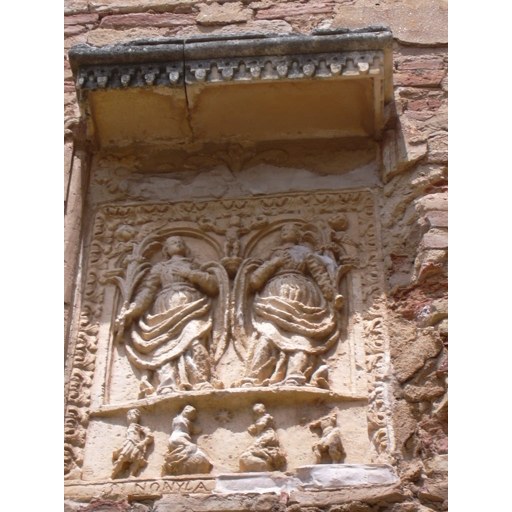
ecelan
License: CC BY 2.5
Nunilo and Alodia
Saint- Life Span
- d. 851
- Feast Day
- 22 October
- Gender
- female
- Church
- Catholic
Places
Relics & Where to Venerate
Location unknown
The relics of Nunilo and Alodia were translated to the Monastery of Leyre in Navarre during the ninth century, though the exact date remains unclear
Roles & Family
Patronage
Adahuesca
Biography
Nunilo and Alodia were two Christian sisters of the ninth century, venerated together as virgin martyrs. They were born in Adahuesca, in the Somontano country near Huesca in what is now Aragon, at a time when that frontier district formed part of the Upper March of the Umayyad Emirate of Córdoba. The hagiographical tradition, which reached Córdoba and was written up by Saint Eulogius in his Memoriale sanctorum, states that their father was a Muslim and their mother a Christian. They were brought up in their mother’s faith, contrary to the expectation under Islamic law that the child of a Muslim father should follow Islam. Their own names, and the later dedication of the parish church of Adahuesca to them, are the principal local traces of their origin; the names of their parents are not preserved in the early notices.
After their father’s death their mother married another Muslim. The sisters then came under sustained pressure to abandon Christianity. They refused. They were denounced to the Islamic authorities and taken to Huesca, where they were examined and imprisoned. The sources describe a prolonged confinement during which they were repeatedly urged to recant. They remained steadfast and were condemned to death. They were executed by beheading. The Roman Martyrology and the bulk of later Catholic tradition assign the martyrdom to 22 October 851, in the reign of the emir Abd al-Rahman II; a minority of accounts have proposed a date in the 840s. Their deaths belong to the wider cluster of mid-ninth-century Christian martyrdoms in al-Andalus, even though they took place on the northern frontier rather than in Córdoba itself.
Eulogius, though he wrote in Córdoba and was chiefly concerned with the Córdoban martyrs, included Nunilo and Alodia among those whose passion he recorded, which helped carry their memory beyond Aragon. They were honoured as holy virgins and martyrs, not as members of a religious order. In the Middle Ages their relics were associated with the royal monastery of San Salvador de Leyre in Navarre, which became a principal centre of their cult; Adahuesca continued to claim them as its own. They have no recorded spouses or children, and the liturgical tradition consistently presents them as unmarried virgins.
The historical dossier is thin. Apart from Eulogius’s brief notice and the later liturgical, monastic, and local traditions of Aragon and Navarre, independent documentary detail—ages, the exact course of the trial, and the first place of burial—is lacking. They were never the object of a modern papal canonization; their cult is of the early, pre-congregational kind. They remain inscribed on 22 October, and they are the patron saints of Adahuesca, where the parish church bears their names.