Nuno Álvares Pereira is a saint of the Catholic Church (1360 - 1431). Nuno Álvares Pereira's feast day is celebrated on 6 November. Nuno Álvares Pereira is the patron saint of Portugal;Portuguese soldiers.
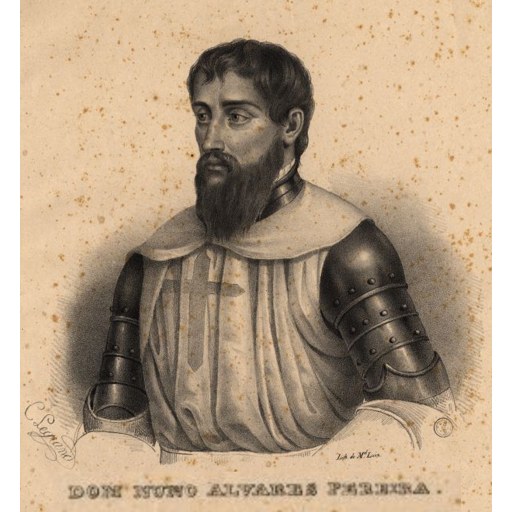
Criado por: Charles Legrand (fl. ca 1838?-1850)
License: Public domain
Nuno Álvares Pereira
Saint- Life Span
- 1360 - 1431 (age 71)
- Feast Day
- 6 November
- Gender
- male
- Church
- Catholic
Places
Relics & Where to Venerate
Location unknown
The bodily remains of Nuno Álvares Pereira are a first-class relic. Venerated at Igreja do Santo Condestável.
Roles & Family
Religious Information
Patronage
Portugal;Portuguese soldiers
Canonization
Biography
Nuno Álvares Pereira was born in 1360 at Cernache do Bonjardim in central Portugal, the illegitimate son of Dom Álvaro Gonçalves Pereira, prior of the Knights Hospitaller at Crato, and Iria Gonçalves do Carvalhal. He was raised among the Portuguese nobility for a military career and was knighted as a young man. In 1376 he married Leonor de Alvim, a noblewoman of the Minho; they had three children, of whom two died young. Their surviving daughter, Beatriz Pereira de Alvim, married Afonso, Count of Barcelos, an illegitimate son of King John I of Portugal, and through that marriage Nuno became an ancestor of the House of Braganza.
In the succession crisis of 1383–1385 that followed the death of King Ferdinand I, Nuno supported the Master of Aviz (the future John I) against the claims of John I of Castile. Appointed Constable of Portugal in 1385, he became the kingdom’s chief military commander. He defeated Castilian forces at Atoleiros in 1384 and, on 14 August 1385, won the decisive Battle of Aljubarrota, where a smaller Portuguese army routed a much larger Castilian host and thereby secured Portuguese independence. Later in 1385 he carried the war into Castile and was victorious at Valverde. These campaigns made him the foremost Portuguese captain of his age.
He subsequently received great lordships, including the counties of Ourém, Barcelos, and Arraiolos. After his wife’s death he remained a widower. Devoted to the Virgin Mary, to whom he attributed his victories, he founded the Carmelite convent and church of Nossa Senhora do Carmo in Lisbon in thanksgiving. In 1423 he resigned his offices and estates, distributed his wealth, and entered that community as a lay brother under the name Nuno of Saint Mary. He lived there in poverty and prayer, performing humble tasks, until his death in Lisbon on 1 November 1431.
Veneration of the Holy Constable began soon after his death. He was beatified by Pope Benedict XV in 1918 and canonized by Pope Benedict XVI on 26 April 2009. His liturgical feast is kept on 6 November. He is remembered both as the soldier who guaranteed Portuguese independence in the late fourteenth century and as a layman who ended his life in the Carmelite cloister.