Octavio, Solutor and Adventor is a saint of the Catholic Church. Octavio, Solutor and Adventor's feast day is celebrated on 20 November. Octavio, Solutor and Adventor is the patron saint of Turin.
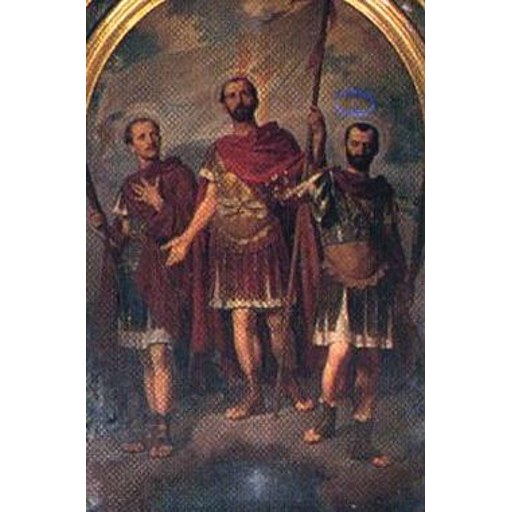
License: Public domain
Octavio, Solutor and Adventor
Saint- Feast Day
- 20 November
- Gender
- male
- Church
- Catholic
Places
Roles & Family
Patronage
Turin
Biography
Octavius, Solutor and Adventor, known in Italian as Ottavio, Solutore and Adventore, are three Christian martyrs venerated as patron saints of Turin in the Piedmont region of northern Italy. Virtually no contemporary documentation of their lives survives, and modern historical scholarship treats the details of their story as legendary. Their public cult in Turin is nevertheless ancient. Saint Maximus of Turin, bishop of the city in the late fourth and early fifth centuries, delivered homilies in their honor, which demonstrates that a local devotion to the three martyrs was already well established by that time. The Roman Martyrology commemorates them on 20 November as soldiers of the Theban Legion who suffered martyrdom under the emperor Maximian.
Medieval and later hagiography identified Adventor, Octavius and Solutor as members of the Theban Legion, a Roman unit said to have been recruited in the Egyptian Thebaid and to have consisted entirely of Christians. According to the legend of Saint Maurice, the legion refused imperial orders to sacrifice to the pagan gods or to join in the persecution of Christians and was massacred at Agaunum (today Saint-Maurice in the Swiss Valais). The three companions are said to have escaped that slaughter, fled into northern Italy, and reached Augusta Taurinorum, the Roman predecessor of Turin. There they were recognized, arrested, and executed for their faith. Historians generally regard the Theban Legion as a hagiographic construct rather than a verified military unit, and they consider the association of the Turin martyrs with that legion to be a later attempt to give a prestigious context to an older local cult. The tradition places the events in the last decades of the third century, during the persecutions connected with Maximian and Diocletian, but no precise year of death can be confirmed from reliable historical sources.
The three saints were buried at Turin, and a martyrium or church arose over their tomb outside the city walls. In the early eleventh century a Benedictine monastery, the abbey of San Solutore, was founded at the burial site. The relics of the martyrs were translated on several occasions in the Middle Ages and early modern period. In the seventeenth century the Jesuits built the Church of the Santi Martiri (Holy Martyrs) in the center of Turin, which became a major shrine of the three saints; relics are also preserved in the Cathedral of Saint John the Baptist in Turin. In Christian art the three are customarily represented as young Roman soldiers holding the palm of martyrdom.
Octavius, Solutor and Adventor are invoked as patrons of the city of Turin. Their feast day is 20 November. Because of the legendary character of the surviving narratives, a detailed biography cannot be reconstructed; what can be affirmed with confidence is the antiquity and continuity of their veneration in Turin from late antiquity through the Middle Ages to the present day.