Odo is a saint of the Catholic Church (d. 942). Odo's feast day is celebrated on 18 November.
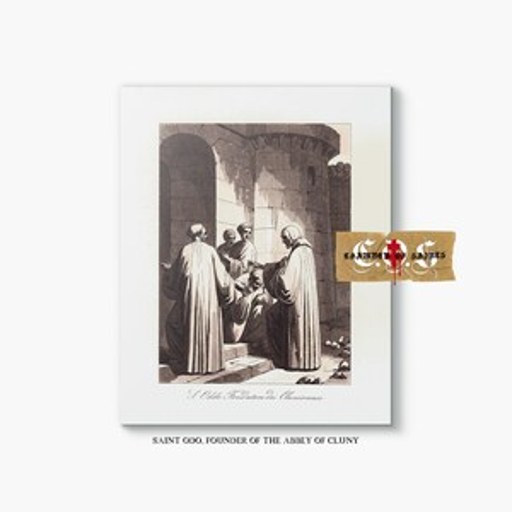
https://www.etsy.com/listing/1340503770/saint-odo-founder-of-the-abbey-of-cluny
License: unknown
Odo
Saint- Life Span
- d. 942
- Feast Day
- 18 November
- Gender
- male
- Church
- Catholic
Places
Roles & Family
Religious Information
Biography
The name Odo belongs to several medieval churchmen; in Latin hagiography the figure most often intended is Saint Odo of Cluny, second abbot of Cluny and a leading monastic reformer of the tenth century. He was born in the later ninth century (traditional dates fall around 878 or 879) into a noble family of West Francia. Early narrative sources name his father as Abbo. The precise place of birth is not securely established: some accounts associate him with Aquitaine, others with the county of Maine near Le Mans. As a youth he spent time at the court of William, Duke of Aquitaine, and received an aristocratic education in letters. According to his medieval biographer he was at first prepared for a secular career, then turned toward religion after illness and a deepening vocation.
Odo became a canon of the church of Saint-Martin at Tours, where he was known for learning and for work in sacred music and the liturgy. Seeking a stricter observance of the Rule of Saint Benedict, he entered the monastery of Baume in Burgundy under Abbot Berno, founder of Cluny (910). He was ordained priest and, after Berno’s death in 927, succeeded him as abbot of Cluny. During his abbacy he obtained papal confirmations of the house’s liberty, including exemption from ordinary episcopal jurisdiction and immediate dependence on the Roman see—an arrangement that became central to the later Cluniac congregation. He also reformed or took under Cluniac care monasteries in Gaul and in Italy and travelled more than once to Rome, where he was drawn into the unsettled politics of the papacy and the Roman nobility in the second quarter of the tenth century.
His surviving writings include a Life of Saint Gerald of Aurillac, presenting a lay noble as a model of Christian virtue; Collationes or moral conferences; sermons; and material connected with liturgy and chant. The principal near-contemporary narrative of his life is the Vita by John of Salerno, a disciple. These sources portray an abbot of marked austerity, intent on restoring common life, silence, and liturgical solemnity, and also on almsgiving and the defence of the weak in a period of weak royal power and frequent local warfare in West Francia. He is associated with efforts to promote ecclesiastical peace amid that violence.
Odo died on 18 November 942 at Tours, at the monastery of Saint-Julien, while returning from a journey, and was buried there. Veneration arose soon afterward in Cluniac and Benedictine circles. His feast is kept on 18 November. Because he lived before the later medieval regularization of papal canonization, no clearly documented single act of canonization by a named pope is known; his sanctity was recognized by monastic cult, liturgical commemoration, and eventual inclusion in martyrologies. Through the privileges he secured and the houses he reformed, he helped make Cluny the most influential monastic institution of the Latin West in the following century.