Odulf of Stavoren is a saint of the Catholic Church (d. 855). Odulf of Stavoren's feast day is celebrated on 12 June. Odulf of Stavoren is the patron saint of Stavoren.
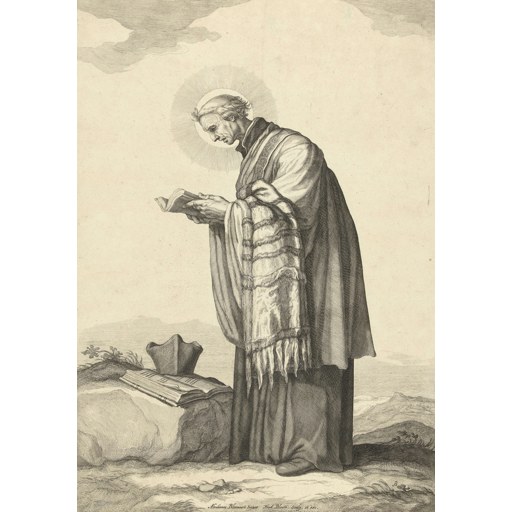
Frederick Bloemaert naar een schilderij van Abraham Bloemaert
License: Public domain
Odulf of Stavoren
Saint- Life Span
- d. 855
- Feast Day
- 12 June
- Gender
- male
- Church
- Catholic
Places
Relics & Where to Venerate
Location unknown
The bodily remains of Odulf of Stavoren are a first-class relic. Venerated at Evesham Abbey.
Roles & Family
Patronage
Stavoren
Biography
Odulf (also known as Odulph, Odulphus, or Odolphus) was a ninth-century missionary priest of the church of Utrecht, later venerated especially in connection with Stavoren in Frisia. Medieval hagiographical tradition, which is late and must be used with caution, presents him as a native of Oirschot in Brabant, born to a family of local standing. He was educated at the cathedral school of Utrecht, then the chief ecclesiastical centre of the northern Frankish lands, under Bishop Frederick of Utrecht (died 838). After ordination he became a canon of the Utrecht cathedral chapter. The sources portray him as a celibate priest of austere life rather than as a member of a later-style religious order.
Frederick sent Odulf to work among the Frisians, whose conversion, begun in the eighth century by Willibrord and Boniface, was still incomplete. Odulf settled at Stavoren (Staveren) on the coast of Westergo, a trading place of rising importance on what later became the Zuiderzee. There he preached, administered the sacraments, and founded a church, remembered in later tradition as dedicated to Saint Martin. He is said to have spent many years in the region, opposing residual pagan custom and organizing Christian life among a population only partly evangelized. Subsequent legend credited him with the origin of the monastic or collegiate community at Stavoren that later bore his name, though the institutional history of that house is medieval rather than contemporary with the saint.
In old age Odulf returned to Utrecht. Tradition places his death there on 12 June 855 and his burial in the city. A cult grew at both Utrecht and Stavoren. The Roman Martyrology commemorates him as a priest of Utrecht on 12 June, which became his principal feast in the Low Countries. He was never the object of a formal papal canonization of the later type; recognition of his sanctity belongs to the older, pre-congregation veneration of a local missionary.
In the eleventh century, after Stavoren had declined through flooding and economic change, relics attributed to Odulf were removed and taken to England, where they were acquired for Eynsham Abbey in Oxfordshire. That translation explains later English dedications to Saint Odulph, including the parish church at Pillaton in Cornwall. On the continent his cult continued in the Netherlands, above all at Stavoren, with further churches under his name in later centuries. The consistent historical core is that of a Utrecht-trained secular priest who worked as a missionary in ninth-century Frisia; almost all personal detail beyond that framework depends on hagiography written well after his lifetime.