Óengus of Tallaght is a saint of the Catholic Church (d. 824). Óengus of Tallaght's feast day is celebrated on 11 March.
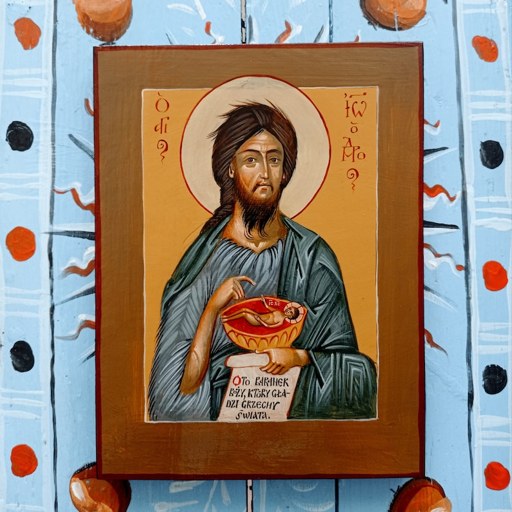
https://www.etsy.com/uk/listing/1518487637/saint-john-the-baptist-picture-icon
License: unknown
Óengus of Tallaght
Saint- Life Span
- d. 824
- Feast Day
- 11 March
- Gender
- male
- Church
- Catholic
Places
Roles & Family
Religious Information
Biography
Óengus of Tallaght, also known as Óengus the Culdee (Irish: Óengus Céile Dé or Óengus mac Óengobann), was an Irish monk, scholar, and hagiographer who flourished in the late eighth and early ninth centuries. He is remembered above all as the author of the Félire Óengusso (The Martyrology of Óengus), a metrical calendar of saints in Old Irish verse and one of the principal liturgical and literary monuments of early medieval Ireland. He belonged to the Céli Dé (Culdee) movement of monastic reform centred on the monastery of Tallaght in what is now County Dublin. Later sources sometimes style him a bishop, but contemporary evidence for episcopal rank is lacking and the title may be honorific or retrospective.
According to medieval prefaces and scholia attached to copies of his martyrology, Óengus was the son of Óengoba and was genealogically linked with the Dál nAraidi of north-eastern Ireland, though such claims cannot be independently verified. He is said to have received his early formation at the monastery of Clonenagh (Cluain Eidnech) in present-day County Laois. Tradition relates that he afterwards lived as a hermit under a severe ascetic rule before attaching himself to the community at Tallaght founded by Saint Máel Ruain (died 792). At Tallaght he is described as having concealed his learning and served in humble offices until his identity as a scholar was discovered. In the circle of Máel Ruain he is associated with the compilation of the Martyrology of Tallaght, a prose listing of saints that became a chief source for his own verse Félire.
The Félire Óengusso was composed around the turn of the ninth century; internal evidence points to a date in the first decade of that century. It comprises a prologue, 365 quatrains assigning one or more saints to each day of the year, and an epilogue. The language is Old Irish and the metre is rinnard. The work draws on the Martyrology of Tallaght and on earlier continental martyrologies, and it became a foundational text for later Irish calendars of saints. Óengus’s writings reflect Céli Dé concerns with liturgical regularity, the commemoration of the saints, and a stricter interpretation of monastic life at a time of perceived decline in Irish churches and of growing Viking pressure on monastic sites.
After Máel Ruain’s death Óengus is said to have withdrawn again to a hermitage, identified in tradition with Disert Óengusa (Dysert Enos or Dysertbeagh) near Clonenagh. His death is traditionally placed on 11 March 824, which is observed as his feast day in Irish martyrologies. He was venerated as a saint in Ireland from an early period; the cult remained essentially local rather than universal, and he was never the subject of a formal papal canonization of the later medieval type. The place of his burial is not securely recorded.