Oliva of Brescia is a saint of the Catholic Church (d. 138). Oliva of Brescia's feast day is celebrated on March 5.
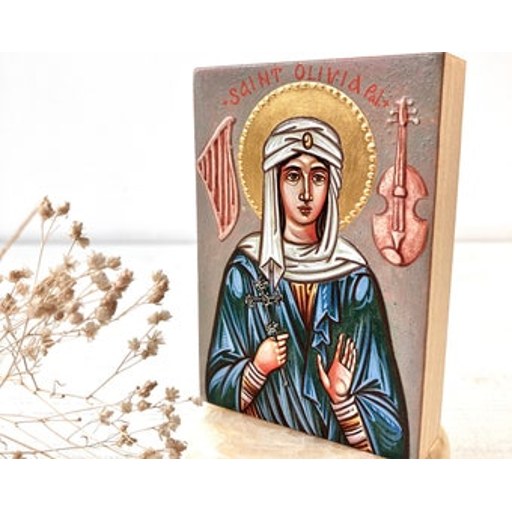
https://www.etsy.com/listing/803667581/saint-olivia-of-palermo-saint-olivia
License: unknown
Oliva of Brescia
Saint- Life Span
- d. 138
- Feast Day
- March 5
- Gender
- female
- Church
- Catholic
Places
Roles & Family
Biography
Saint Oliva of Brescia is a Christian martyr associated with the city of Brescia in northern Italy and traditionally placed in the second century of the Roman imperial period. Almost nothing about her can be established from contemporary documents. No early passion, inscription, or ecclesiastical record that modern historians would treat as independent evidence of her life has survived, and the notices that do exist belong to later martyrological and local tradition. According to that tradition she was put to death at Brescia around the year 138, in the closing part of the reign of the emperor Hadrian (117–138), a period to which later legend also assigned other Brescian martyrs. The year, the imperial setting, and even the precise form of her name rest on hagiographical convention rather than on a datable historical act.
Brescia (Roman Brixia) was a municipium in Cisalpine Gaul whose Christian community is better known through the cult of Saints Faustinus and Jovita, the city’s principal patrons, whose legendary acts likewise situate their deaths under Hadrian. Oliva’s name appears in some listings of Brescian martyrs and in later calendars, but she does not occupy a comparable place in the great medieval legendaries, and she is not among the most prominent entries of the Roman Martyrology in its modern typical edition. Devotion to her seems to have been essentially local. Particulars frequently attached to female martyrs of this era—noble parentage, a public refusal to sacrifice to the gods, a named judge, or a specified manner of execution—are not securely recorded for her and should not be supplied by analogy with better-known passions.
Even elementary biographical facts remain unknown. Her place of birth is not documented; the epithet “of Brescia” may indicate origin, place of martyrdom, or merely the centre of her cult. Whether she was a consecrated virgin, a lay Christian, married, or the mother of children is not established by any reliable source. No religious order can be associated with her, as the later monastic orders did not exist in the second century. She was not a bishop, pope, or patriarch. Veneration of such early martyrs arose by popular cult and local liturgical memory long before the medieval and modern papal processes of beatification and canonization; no decree of a named pope conferring those honours upon her is recorded. Later calendars have assigned her a feast on 5 March, but that date, like the traditional year of death, is a matter of received usage rather than of a verifiable historical anniversary.
In the wider history of early Italian Christianity, Oliva belongs to the large number of shadowy martyrs whose names were preserved in local churches and eventually entered compilations of saints, even when original acts had been lost or had never been written. The strongest indication that a Christian woman so named was remembered as a martyr at Brescia is the existence of that local cult; the placement of her death in 138 under Hadrian reflects the common medieval practice of locating otherwise undated local martyrs within well-known imperial persecutions. No writings, undisputed relics, or contemporary inscriptions can be firmly tied to her. Any reconstruction beyond her identity as a female Christian martyr connected with Brescia in the early Roman imperial period, and beyond her traditional commemoration, must therefore remain tentative.