Onesiphorus is a saint of the Eastern Orthodox Church. Onesiphorus's feast day is celebrated on 6 September (Roman Martyrology); 7 September and 8 December (Eastern Orthodox); 4 January (Synaxis of the Seventy Apostles).
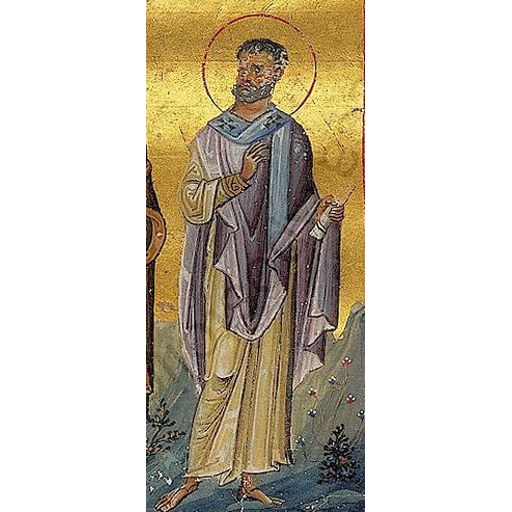
Authors of Menologion of Basil II (circa 985 AC, Constantinople), Byzantine manuscript illuminators[1]: Pantoleon with Georgios, Michael the Younger, Michael of Blachernae, Symeon, Symeon of Blachernae, Menas, and Nestor (Online on Vatican site)
License: Public domain
Onesiphorus
Saint- Feast Day
- 6 September (Roman Martyrology); 7 September and 8 December (Eastern Orthodox); 4 January (Synaxis of the Seventy Apostles)
- Gender
- male
- Church
- Eastern Orthodox
Places
Roles & Family
Biography
Onesiphorus (Greek: Onesiphoros, meaning "bringing profit" or "profit-bearer") is a Christian of the first century known principally from the New Testament. In the Second Epistle to Timothy, the Apostle Paul commends him by name. Paul asks that the Lord grant mercy to the household of Onesiphorus, because Onesiphorus often refreshed him and was not ashamed of Paul's imprisonment. The letter states that when Onesiphorus came to Rome he searched diligently for Paul and found him, and it recalls how much service he had rendered at Ephesus. In a later greeting Paul asks that Prisca and Aquila and the household of Onesiphorus be saluted. These passages place Onesiphorus in the circle of Pauline coworkers in the Roman province of Asia and in the capital during the period of Paul's captivity, generally assigned to the mid-first century.
The New Testament does not record Onesiphorus's birth, parentage, or death. His association with Ephesus is firm in the biblical text, but it is not stated that he was born there. The repeated reference to his household has been read in different ways: as evidence that he headed a family or a domestic church, or, because Paul greets the household rather than the man himself in one verse and prays that Onesiphorus may find mercy from the Lord on that day, as a possible indication that Onesiphorus had already died when the letter was composed. The latter reading has sometimes been cited in later Christian discussion of prayer for the dead. None of these inferences is certain. There is no scriptural testimony that he was married or that he had children, and no contemporary record of a burial place.
Later ecclesiastical tradition, especially in the Greek East, numbered Onesiphorus among the Seventy Apostles whom Jesus sent out according to the Gospel of Luke. Medieval lists of the Seventy, associated with the names of Hippolytus of Rome and Dorotheus of Tyre, identify him as bishop of Colophon in Asia Minor; other notices also connect him with Corinth. These episcopal titles belong to hagiographical compilation rather than to first-century documentation. They reflect the churches' desire to give the Pauline coworker a place in the apostolic succession of Asia and Greece, but they cannot be verified from sources contemporary with Onesiphorus himself. He was not Bishop of Rome and did not hold a patriarchal see, nor is he associated with any later religious order.
A separate strand of martyrology commemorates Saints Onesiphorus and Porphyrius as having suffered at Parium (Parion) on the Hellespont in Mysia. Synaxaria describe them as bound to wild horses and dragged to death; some Western notices place a passion of Onesiphorus and Porphyrius in the persecution under Diocletian in the late third or early fourth century. Whether this martyr pair is identical with the biblical Onesiphorus, or whether later tradition fused a first-century disciple with later Asian martyrs of the same name, remains unresolved. Careful historians therefore treat the Parium passion as liturgical tradition rather than as a confirmed biography of the figure in Second Timothy. The Roman Martyrology has kept 6 September for Onesiphorus; the Byzantine calendar commemorates martyrs Onesiphorus and Porphyrius on 7 September, remembers Onesiphorus among apostles of the Seventy on 8 December, and includes him in the Synaxis of the Seventy Apostles on 4 January.
No ancient source of independent historical weight records his year of birth or death, a spouse, or children. He is venerated as a saint in the Eastern Orthodox and Roman Catholic churches by ancient cultus, without a medieval or modern process of formal canonization or beatification. Standard martyrologies do not attach to him a well-defined list of patronages of places, professions, or causes. What can be said with confidence is that a Christian named Onesiphorus, linked to Ephesus, aided Paul in Asia and sought him out in Rome, and that the churches thereafter honored his memory under several related commemorations.