Onuphrius is a venerable of the Catholic Church (d. 400). Onuphrius's feast day is celebrated on 12 June. Onuphrius is the patron saint of weavers;hermits;Sutera.
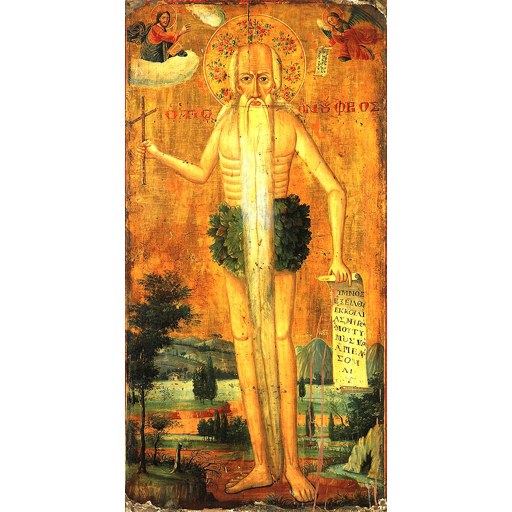
License: Public domain
Onuphrius
Venerable- Life Span
- d. 400
- Feast Day
- 12 June
- Gender
- male
- Church
- Catholic
Places
Roles & Family
Patronage
weavers;hermits;Sutera
Canonization
Biography
Saint Onuphrius (Greek: Onouphrios; also Onofre, Onofrio, and in medieval England Humphrey) was a Christian hermit of Egypt, numbered among the Desert Fathers and venerated in the Catholic, Eastern Orthodox, and Oriental Orthodox churches. He is generally placed in the fourth century; a traditional date of death around 400 is widely repeated in synaxaria and martyrologies, though it is hagiographical rather than independently documented. Almost everything known of him derives from the narrative of Paphnutius the Ascetic (Paphnutius of Scetis or of Thebes), who described a journey into the inner desert of Upper Egypt and encounters with solitaries. No contemporary archival source confirms the details. Later medieval lives added that Onuphrius was a king’s son from Persia or Ethiopia who fled to Egypt; those elaborations are absent from the earlier Paphnutius tradition and are not treated as historical.
According to Paphnutius, Onuphrius had first been a monk in a cenobium in the Thebaid of Upper Egypt. Seeking a stricter solitude after the example of the prophet Elijah and of John the Baptist, he left communal life and withdrew into the remote desert, where he remained for some sixty or seventy years. When Paphnutius found him, he was extremely old, his body covered with long hair that served as a garment, and he wore only a loincloth of leaves or palm fiber. He related that the first years of eremitical life had been marked by hunger, thirst, and temptation, but that thereafter an angel brought him the Eucharist on Sundays and a date palm and a spring supplied food and water. He presented the desert life as a martyrdom of patience rather than of blood.
Onuphrius died the day after this meeting. Paphnutius buried him in the desert, in a cleft of rock or a shallow grave; the narrative states that the palm tree and the hermit’s dwelling then vanished, so that no enduring tomb marked the original site. The story circulated in Greek, Coptic, Syriac, Latin, and later vernacular versions and became one of the best-known desert-father legends in both East and West. Churches and monasteries were dedicated to him across the Christian East and, from the Middle Ages, in Italy, Sicily, Spain, and Portugal. The church of Sant’Onofrio al Gianicolo in Rome is among the principal Western shrines associated with his cult. Because veneration began in late antiquity, he is a pre-congregation saint and was not the subject of a later formal papal canonization.
In art he appears as an emaciated, long-bearded old man, often covered by his own hair except for a leafy girdle, sometimes with an angel bearing Communion or with a palm tree. His feast is 12 June in the Roman Martyrology and in the Byzantine synaxaria; the Coptic Church commemorates him on 16 Paoni. He is invoked as a patron of weavers, an association drawn from the leaf or fiber garment of the legend, as a model of hermits, and as patron of Sutera in Sicily. His year and place of birth, and many later biographical particulars, remain unknown.