Opportuna of Montreuil is a saint of the Catholic Church (d. 770). Opportuna of Montreuil's feast day is celebrated on 22 April.
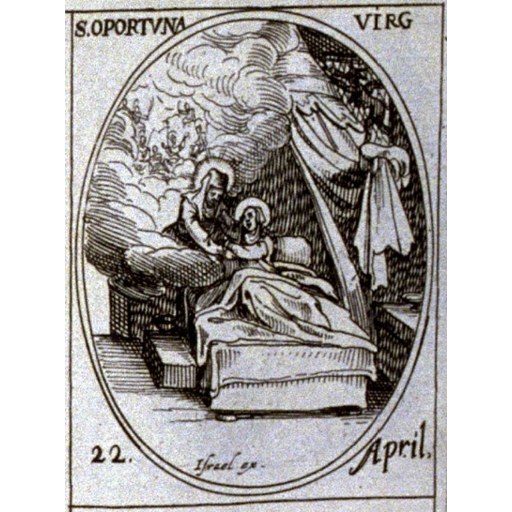
Jacques Callot
License: Public domain
Opportuna of Montreuil
Saint- Life Span
- d. 770
- Feast Day
- 22 April
- Gender
- female
- Church
- Catholic
Places
Roles & Family
Religious Information
Biography
Saint Opportuna of Montreuil was a Frankish Benedictine nun and abbess of the eighth century, venerated in the Catholic Church as a virgin saint. The principal narrative of her life is the Vita et miracula Sanctae Opportunae, composed in the later ninth century by Adalhelm (also called Adelhelm), bishop of Séez, who presented himself as a kinsman of the saint. According to this tradition she was born of a noble family linked with the counts of Argentan, at a castle in the neighborhood of Exmes (also called Hiesmes) in the diocese of Séez, in Neustria. She was the sister of Saint Chrodegang, also known as Godegrand, who became bishop of Séez. No contemporary document records the year of her birth, and later writers who supply one do so only by conjecture.
In youth she received the religious veil from her brother and entered the Benedictine monastery of Monasteriolum, generally identified with Montreuil in the vicinity of Almenêches. The abbess of the house was a relative, named in some accounts as her cousin Lantildis. Opportuna later became abbess of the community, which later tradition associates with the nunnery of Almenêches in what is now the department of Orne in Normandy. The Vita depicts her as austere in personal observance, generous to the poor, and vigilant over the convent’s lands and livestock. Two stories in particular became attached to her lifetime. In one, a peasant stole an ass belonging to the nuns and denied the theft; at the abbess’s word the animal itself approached the man’s dwelling and knocked, so that the crime was revealed. In another, a man who had worked on Sunday found his hand fixed to his axe until he sought Opportuna’s prayers and promised to keep the Lord’s Day.
Her brother the bishop was killed by a relative while returning from a pilgrimage to Rome. Hagiographic tradition states that Opportuna learned of the murder through a vision, recovered the body, and saw to its burial. She herself fell ill shortly afterward. She died on 22 April, the day kept as her feast; medieval calendars and later martyrologies commonly give the year as 770, a figure that rests on received tradition rather than a strictly contemporary annal. She was buried at her monastery.
In the ninth and tenth centuries Norse raids on the Norman coast and interior disrupted the houses that had preserved her memory, and her relics were translated in stages. Portions were taken to Moussy-le-Neuf in the Île-de-France and to Paris, where the church of Sainte-Opportune became a centre of her cult. She has been honoured as a virgin and abbess. Because her veneration arose in the age of local cults, no papal canonization in the later juridical sense is recorded. The historical core that can be affirmed with caution is that of a noble-born Benedictine abbess of the Séez region in the eighth century, around whom a coherent body of miracle stories and family tradition had already gathered within a century of her death.