Osgyth is a saint of the Catholic Church (d. 700). Osgyth's feast day is celebrated on 7 October. Osgyth is the patron saint of St Osyth.
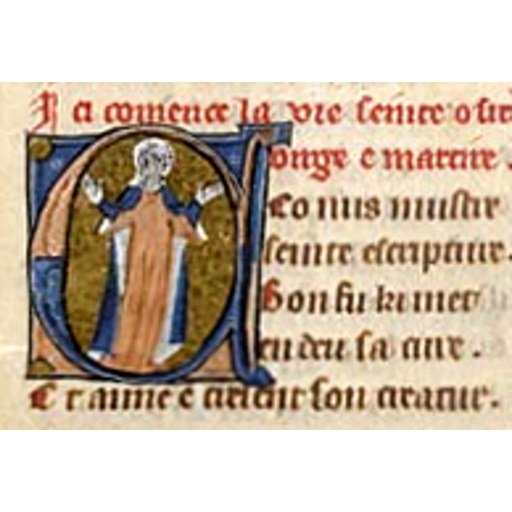
Unknown authorUnknown author
License: Public domain
Osgyth
Saint- Life Span
- d. 700
- Feast Day
- 7 October
- Gender
- female
- Church
- Catholic
Places
Roles & Family
Religious Information
Patronage
St Osyth
Biography
Osgyth, also recorded as Osyth, Osith, and Sythe, was a seventh-century Anglo-Saxon noblewoman who became abbess of a monastery at Chich in Essex and was later venerated as a saint. Almost everything that is known of her derives from medieval legend rather than from contemporary witnesses such as Bede. Tradition makes her the daughter of Frithuwald, a sub-king of Surrey under Mercian overlordship, and of Wilburh, said to have been a daughter of King Penda of Mercia. She is reported to have been born at Quarrendon in Buckinghamshire and to have been educated in piety by relatives, among them Saint Edith of Aylesbury. From an early age, according to the later lives, she wished to enter the religious life.
She was nevertheless married to Sigehere, king of the East Saxons, a ruler who appears in Bede’s Ecclesiastical History as joint king of Essex with Sæbbi in the later seventh century. The hagiographers insist that Osgyth had already bound herself by a vow of virginity. In the most familiar episode, a white stag appeared in the midst of the wedding celebrations; while Sigehere rode away to the hunt, Osgyth escaped to a bishop, received the veil, and was in time granted by her husband the estate of Chich (Cicce) on the Essex shore. There she founded a community of nuns and governed it as abbess. Whether the marriage produced children is not established by any reliable source; later writers sometimes associate Offa of Essex with Sigehere, but Osgyth’s maternity is unproven.
Her passio recounts that sea-raiders, frequently and anachronistically called Danes, landed near the monastery and demanded that she renounce her faith. When she refused, they beheaded her. The legend then presents her as a cephalophore: she lifted her own head and walked to the church, and a spring marked the place where her blood had fallen. The conventional date assigned to her death is about the year 700. That chronology sits uneasily with genuine Viking activity, which belongs to a later age, and it is possible that a seventh-century abbess was subsequently recast as a martyr or that separate stories were combined. No seventh- or eighth-century chronicle mentions her.
A church at Chich was dedicated to Osgyth, and her relics became the centre of a regional cult. Early in the twelfth century Richard de Belmeis, bishop of London, founded an Augustinian priory on the site and translated her remains into its church. The house, known as St Osyth’s Priory, became one of the more important Augustinian communities in Essex, and the adjoining settlement took the saint’s name. Her feast day is 7 October. Documented patronages beyond the place that bears her name are few, and the details of her biography must be treated with caution because they rest largely on twelfth-century and later hagiography.