Our Lady of Montserrat is a saint of the Catholic Church. Our Lady of Montserrat's feast day is celebrated on 27 April. Our Lady of Montserrat is the patron saint of Catalonia.
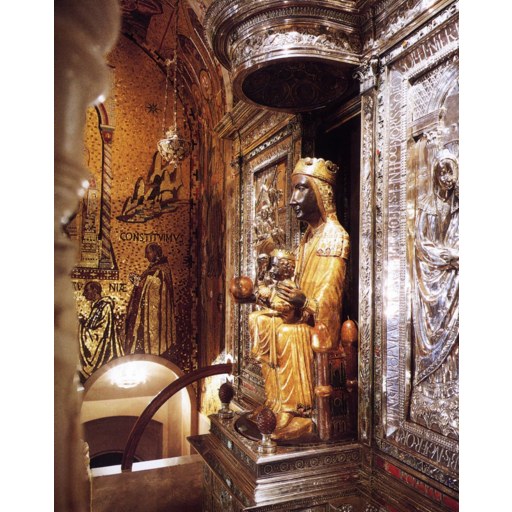
Departament de Premsa i Comunicació de Montserrat
License: Public domain
Our Lady of Montserrat
Saint- Feast Day
- 27 April
- Gender
- female
- Church
- Catholic
Places

Roles & Family
Patronage
Catalonia
Biography
Our Lady of Montserrat, known in Catalan as Mare de Déu de Montserrat and popularly called La Moreneta (the little dark one), is a seated wooden statue of the Madonna and Child venerated in the basilica of the Benedictine abbey of Santa Maria de Montserrat on the mountain of Montserrat in Catalonia, Spain. The polychrome Romanesque sculpture, about ninety-five centimeters high, presents the Virgin as Sedes Sapientiae, enthroned with the Child Jesus on her lap. She holds a sphere in her right hand; the Child blesses with his right hand and holds a pinecone in his left. The darkened faces and hands that earned the image its nickname have been explained as the result of aged varnish, centuries of candle smoke, or original coloring of the wood. Art-historical consensus places the existing statue in the late twelfth century rather than in apostolic times.
A later medieval legend claimed that Saint Luke carved the image and that Saint Peter brought it to Catalonia. During the eighth-century Muslim conquest of Iberia the statue was said to have been hidden in a cave on Montserrat. In 880, according to the same tradition, shepherd children from Monistrol saw mysterious lights and heard singing on the mountain. Their parish priest and Bishop Gotmar of Vic investigated and found the image. When the bishop tried to carry it to Manresa it became immovable, which was taken as a sign that the Virgin wished to remain on the mountain. A chapel and then a monastery were founded there. Contemporary charters confirm a monastic presence at Montserrat by the late ninth century, and the shrine grew into a major pilgrimage center in the High Middle Ages, receiving papal privileges and royal patronage from the counts of Barcelona and the kings of Aragon. The legendary discovery story cannot be verified from ninth-century documents, but it shaped later devotion and local identity.
The abbey was sacked and largely destroyed by Napoleonic troops in 1811 and 1812 during the Peninsular War; monks hid the statue, which survived. The community and buildings were restored in the nineteenth century. On 11 September 1881 Pope Leo XIII granted the image a canonical coronation and declared Our Lady of Montserrat patroness of Catalonia. The statue is enthroned in a silver altarpiece above the high altar; pilgrims ascend a short stair to touch or kiss the orb in the Virgin’s right hand. The Escolania de Montserrat, among the oldest surviving boys’ choirs in Europe, sings the Virolai and the Salve daily before the image. The mountain, with its distinctive saw-toothed peaks, remains both a religious sanctuary and a symbol of Catalan identity.
Devotion traveled with Catalan and Spanish sailors and missionaries. In 1493 Christopher Columbus named the Caribbean island of Montserrat after the mountain and its Madonna. Copies of the statue and dedicated churches are found in Latin America, the Philippines, and other regions of former Spanish influence. The liturgical memorial of Our Lady of Montserrat is kept on 27 April, especially in Catalonia, where the shrine continues to draw large numbers of pilgrims and visitors. The subject of this cult is a venerated image and Marian title, not a historical person with a recorded birth, death, or burial; personal biographical fields such as birth year therefore cannot be supplied from reliable sources.