Pancras is a saint of the Catholic Church (d. 304). Pancras's feast day is celebrated on 12 May. Pancras is the patron saint of children;youth;against cramps;against headaches;against perjury;against false witness;oaths and treaties;St Pancras (London).
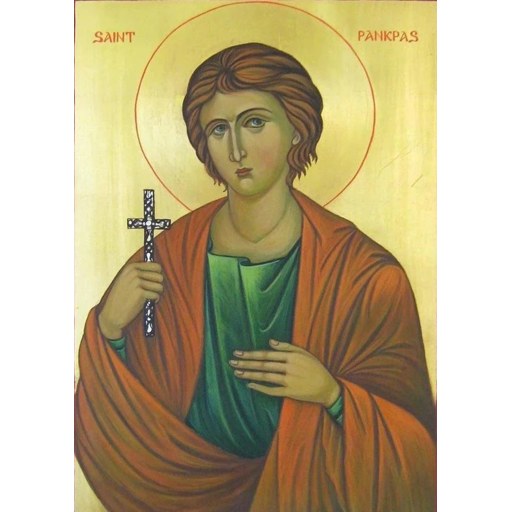
https://handmadeiconsgreece.myshopify.com/en-us/products/saint-pancras-of-rome
License: unknown
Pancras
Saint- Life Span
- d. 304
- Feast Day
- 12 May
- Gender
- male
- Church
- Catholic
Places
Roles & Family
Patronage
children;youth;against cramps;against headaches;against perjury;against false witness;oaths and treaties;St Pancras (London)
Biography
Saint Pancras (Latin Pancratius) is a Roman martyr of the early fourth century whose cult is among the oldest continuously attested in the city of Rome. The surviving Passio, a late and largely conventional hagiographical text, presents him as a youth of noble Phrygian family who, after the death of his parents, was brought to Rome by his uncle Dionysius. There both are said to have embraced Christianity. During the persecution associated with the emperor Diocletian the boy, traditionally fourteen years of age, was arraigned, refused to offer sacrifice to the gods, and was beheaded. The traditional date of the martyrdom is 12 May 304. Modern hagiographers treat the narrative details of the Passio with caution: what can be affirmed with greater confidence is that a martyr named Pancratius was buried in the cemetery of Calepodius (also associated with the cemetery of Ottavilla) on the Via Aurelia and that his tomb was already a public cult site by the fifth century.
The architectural history of the shrine is better documented than the saint’s biography. Pope Symmachus (498–514) built or rebuilt a basilica over the grave. Pope Honorius I (625–638) reconstructed the church on a larger scale; it became a station church and a goal of pilgrimage. Gregory of Tours, writing in the late sixth century, already records miracles at the tomb and relates that those who swore falsely there were struck down, a tradition that later made Pancras a special guardian of oaths and a terror to perjurers. Relics attributed to him were widely distributed in the early Middle Ages. Gregory the Great is said to have given relics to Augustine of Canterbury, and a church of St Pancras was among the earliest dedications in Anglo-Saxon England. The present Basilica of San Pancrazio fuori le Mura still stands on the Janiculum near the original burial ground.
The feast of Saint Pancras is kept on 12 May in the General Roman Calendar. In popular weather lore of Central Europe he is counted among the “Ice Saints” (with Servatius and Boniface of Tarsus), whose mid-May feasts were associated with the risk of late frost. He is invoked as a patron of children and of the young, and against cramps, headaches, perjury, and false witness. The ancient parish and later metropolitan borough and railway station of St Pancras in London take their name from a church dedicated to him. Because the Passio is late and stereotyped, little can be established about his family, exact birthplace, or the precise judicial circumstances of his death beyond the early, stable, and geographically widespread cult of a youthful Roman martyr of this name.