Pantaleon is a saint of the Catholic Church (d. 305). Pantaleon's feast day is celebrated on 27 July. Pantaleon is the patron saint of physicians;doctors;midwives;the sick;against headaches;against tuberculosis;livestock;against loneliness;against locusts;Nicomedia.
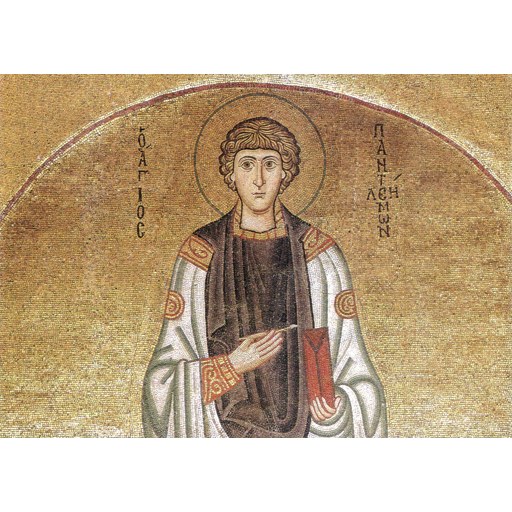
AnonymousUnknown author
License: Public domain
Pantaleon
Saint- Life Span
- d. 305
- Feast Day
- 27 July
- Gender
- male
- Church
- Catholic
Places


Roles & Family
Patronage
physicians;doctors;midwives;the sick;against headaches;against tuberculosis;livestock;against loneliness;against locusts;Nicomedia
Biography
Saint Pantaleon, called Panteleimon in the Greek East (from a title meaning all-compassionate), is venerated as a martyr of Nicomedia in Bithynia and as a physician-saint. The surviving Greek and Latin Acts of his passion are late and heavily legendary, and they cannot be used as a contemporary biography; they do, however, preserve the core of an early cult centred on a Christian healer put to death in Nicomedia during the Diocletianic persecution. Tradition makes him the son of a prosperous pagan, Eustorgius, and of a Christian mother, Eubula (or Euboule), who instructed him in the faith. After her death he is said to have neglected Christianity while he trained as a physician and entered the service of the imperial court at Nicomedia, then a principal residence of the eastern emperors of the Tetrarchy.
According to the legend, a priest named Hermolaus rebuked him for his apostasy and taught him that Christ alone is the true physician of souls and bodies. Pantaleon then healed a blind man by invoking the name of Jesus, a sign that also converted his father. Thereafter he treated the sick without payment, giving away his inheritance to the poor, and so became a model of the unmercenary healer later honoured in Eastern Christian devotion. When edicts against Christians were posted in Nicomedia at the opening of the Great Persecution in 303, he was accused before the emperor of being a Christian and of having abandoned the gods. The passion texts name Maximian or Galerius as the ruler who heard the case.
The legendary narrative subjects him to a catalogue of tortures typical of later martyr romances: he was stretched on the rack, burned with torches, plunged into molten lead, cast into the sea with a stone, exposed to wild beasts, and bound upon a wheel, all of which he survived through divine intervention. He was at last beheaded, traditionally on 27 July 305. The story adds that milk flowed from his neck in place of blood and that an olive tree to which he had been tied immediately bore fruit. Three companions, Hermolaus, Hermippus, and Hermocrates, were executed with him. None of these details can be confirmed from independent fourth-century sources, and modern historians treat the Acts as hagiographical romance rather than reportage.
A cult of Pantaleon is nevertheless ancient. Theodoret of Cyrrhus in the fifth century already knew him as a recognised martyr. Churches in his honour stood in Constantinople by the sixth century, and imperial patronage is associated with his veneration there. In the Byzantine calendar he is numbered among the Great Martyrs and the Holy Unmercenaries (anargyroi), physicians who healed freely. Relics attributed to him were kept in the capital and, after the Fourth Crusade of 1204, were claimed by a number of Western churches, including the cathedral of Lyon, San Pantalon in Venice, and the cathedral of Ravello. In the later Middle Ages the West enrolled him among the Fourteen Holy Helpers, saints invoked against plague and sudden death. His feast is kept on 27 July in both East and West. He is the patron of physicians and midwives and has been invoked against headaches, tuberculosis, and other illnesses. Beyond the early and widespread devotion to a martyred physician of Nicomedia, the particulars of his life remain unknown.