Paphnutius of Thebes is a saint of the Catholic Church. Paphnutius of Thebes's feast day is celebrated on 11 September.
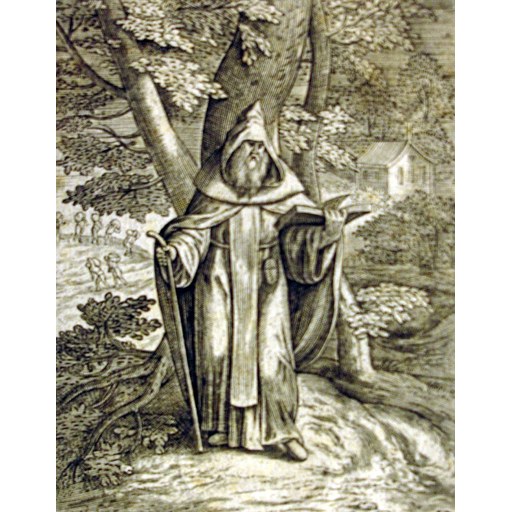
Anonymous after Raphael Sadelers' Solitudo Sive Vitae Patrum Eremicolarum (1594-1598)
License: Public domain
Paphnutius of Thebes
Saint- Feast Day
- 11 September
- Gender
- male
- Church
- Catholic
Places
Roles & Family
Biography
Paphnutius of Thebes, often called Paphnutius the Confessor, was a fourth-century Egyptian bishop and monastic figure from the Thebaid in Upper Egypt. The principal early notices of him come from the fifth-century church historians Socrates Scholasticus and Sozomen, with additional remarks in Rufinus of Aquileia. These writers present him as a disciple of the desert ascetic Anthony the Great and as one of the confessors of the last great pagan persecution of Christians in Egypt. During the persecution associated with the emperor Maximinus Daia in the early fourth century, he was mutilated: his right eye was gouged out and the sinews of his left leg or ham were cut, after which he was condemned to labor in the mines. When persecution ended under Constantine, he was freed and became bishop of a city in the Upper Thebaid. The ancient historians do not preserve the name of that see, and later attempts to identify it remain conjectural.
After his release he was held in high honor for his sufferings. Socrates and Sozomen report that Constantine himself treated Paphnutius with marked reverence, even kissing the empty socket of the missing eye. As a monastic bishop he belonged to the generation that joined the desert tradition of Anthony to the public life of the Constantinian church. He took part in the First Council of Nicaea in 325, where he is remembered as a defender of the faith against Arian teaching and as a man whose bodily wounds gave moral weight to his words. Later tradition also places him among supporters of Athanasius of Alexandria in the conflicts that followed Nicaea. Rufinus and subsequent writers associate him with the defense of Athanasius around the time of the Council of Tyre in 335 and related gatherings, though the surviving evidence for these later appearances is thinner than for Nicaea and must be used with caution.
The episode for which he is most often cited is an intervention at Nicaea concerning clerical marriage. According to Socrates, some fathers wished to require that men already married when ordained should thereafter live apart from their wives. Paphnutius, himself a monk and described as unmarried and of strict continence, is said to have opposed the proposal. He argued that marriage was honorable and the marriage bed undefiled, that the church should not lay a new and heavier burden on clergy, and that those who had married before ordination should not be separated from their spouses, while forbidding marriage after ordination in keeping with existing custom. The council, in this account, followed his advice. The story is not reflected as a rejected draft in the official Nicene canons and is first narrated by fifth-century Greek historians; modern scholars have therefore debated whether it is a genuine Nicene incident or a later anecdote shaped by subsequent disputes over clerical celibacy. It remains, however, the core of his medieval reputation in both East and West.
Nothing certain can be said about the date or place of his death. No contemporary source records a year, and later notices that assign a mid-fourth-century date are not securely grounded in early evidence. He was commemorated as a confessor-bishop in martyrological tradition; the Roman Martyrology lists him on 11 September, recalling both his mutilation under Maximinus and his stand at Nicaea. Several other Egyptian monks and bishops of the fourth and fifth centuries bore the name Paphnutius, including ascetics connected with Scetis and Heracleopolis, and later hagiography sometimes blends their deeds. A cautious portrait therefore rests on the brief, relatively sober notices in Socrates, Sozomen, and Rufinus: an Egyptian confessor-monk of the Thebaid, mutilated in the last persecution, bishop of an unnamed Upper Egyptian see, present at Nicaea, and remembered as a virgin monk who nonetheless spoke for the honor of clerical marriage as the church of his time understood it.