Paul is a saint of the Catholic Church. Paul's feast day is celebrated on 29 June. Paul is the patron saint of missionaries;theologians;evangelists;tentmakers;weavers;Malta;Rome;Gentile Christians.
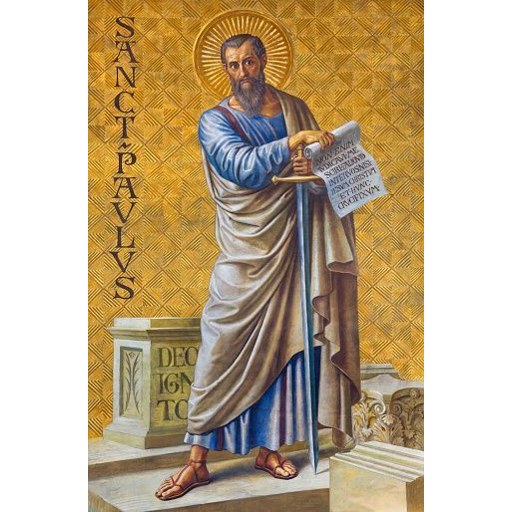
https://www.pinterest.com/ideas/st-paul-the-apostle/947708616332/
License: unknown
Paul
Saint- Feast Day
- 29 June
- Gender
- male
- Church
- Catholic
Places
Roles & Family
Patronage
missionaries;theologians;evangelists;tentmakers;weavers;Malta;Rome;Gentile Christians
Biography
Paul, known before his conversion as Saul of Tarsus, was a first-century Jew of the tribe of Benjamin, a Pharisee, and a Roman citizen whose life and letters shaped the early Christian movement more than those of any other single figure after Jesus. He was born in Tarsus, a major city of Cilicia in Asia Minor, and later recalled that he had been brought up in Jerusalem and educated at the feet of Gamaliel, a respected teacher of the Law. In the years immediately following the crucifixion of Jesus, Saul was a determined opponent of the disciples. The Acts of the Apostles depicts him as present at the stoning of Stephen and as obtaining authority to arrest believers in Damascus. His own letters confirm that he had persecuted the church of God and tried to destroy it.
According to Acts, while he was on the road to Damascus he was confronted by a light from heaven and heard the voice of Jesus asking why he persecuted him. Rendered blind, he was led into the city, where a disciple named Ananias laid hands on him, restored his sight, and baptized him. Paul thereafter proclaimed that Jesus was the Son of God. He spent time in Arabia and Damascus, made a brief visit to Jerusalem to meet Cephas (Peter) and James, and later worked for years in Syria and Cilicia before being brought by Barnabas to Antioch. From Antioch he undertook the journeys that carried the gospel through Cyprus, Asia Minor, Macedonia, and Achaia. He founded or strengthened communities in Philippi, Thessalonica, Corinth, Ephesus, and other cities, and he argued, against some Jewish Christians, that Gentile believers were not bound to circumcision and the ceremonial Law. The so-called Council of Jerusalem, described in Acts 15 and reflected in Galatians, ratified a form of that position.
A substantial corpus of letters in the New Testament bears Paul’s name. Critical scholarship generally accepts as authentic Romans, 1 and 2 Corinthians, Galatians, Philippians, 1 Thessalonians, and Philemon; the authorship of 2 Thessalonians, Colossians, Ephesians, and the Pastoral Epistles is more widely disputed. In these writings Paul develops a theology of justification by faith, of the church as the body of Christ, of baptism and the Lord’s Supper, and of the impending return of Christ. He describes himself as apostle to the Gentiles, a calling he understood as rooted in God’s purpose rather than in human appointment. His ministry was marked by hardship: flogging, imprisonment, shipwreck, and conflict with rival teachers. After a riot in Jerusalem he was taken into Roman custody, held for two years at Caesarea, and, having appealed to Caesar, was sent under guard to Rome, surviving a shipwreck on Malta.
The narrative of Acts closes with Paul living under house arrest in Rome and preaching without hindrance. Subsequent Christian tradition, already voiced by Clement of Rome in the late first century and by later writers such as Dionysius of Corinth, Irenaeus, and Tertullian, holds that he was executed in Rome during the Neronian persecution, by beheading, in keeping with his citizenship. The site of his burial on the Ostian Way became a place of pilgrimage; over it rose the basilica known as Saint Paul Outside the Walls, where a sarcophagus venerated as his tomb remains. He was never the object of a medieval papal canonization, because veneration of the apostles is of apostolic and sub-apostolic origin.
In the liturgical calendars of East and West, Paul is commemorated with the Apostle Peter on 29 June. The Latin church also keeps the feast of his Conversion on 25 January. He is honored as patron of missionaries and theologians, of tentmakers and related crafts, of the island of Malta, and, together with Peter, of the city of Rome. His letters have remained a principal source for Christian doctrine, spirituality, and ethics across the churches, and his figure stands at the center of debates about Law and gospel, Jew and Gentile, and the meaning of apostleship.