Paul of Tobolsk is a saint of the Catholic Church (1705 - 1770). Paul of Tobolsk's feast day is celebrated on 4 November.
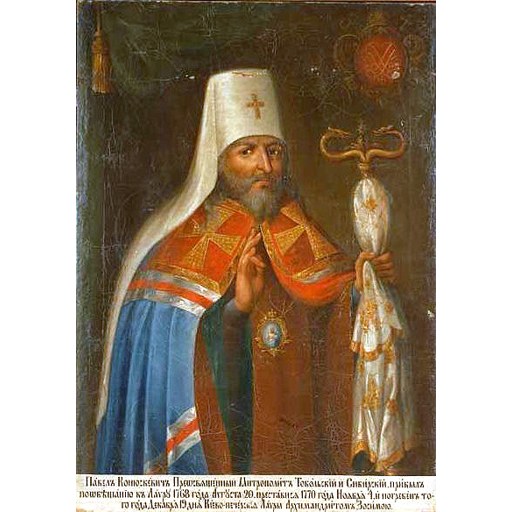
AnonymousUnknown author
License: Public domain
Paul of Tobolsk
Saint- Life Span
- 1705 - 1770 (age 65)
- Feast Day
- 4 November
- Gender
- male
- Church
- Catholic
Places
Relics & Where to Venerate
Location unknown
The bodily remains of Paul of Tobolsk are a first-class relic. Venerated at Kyiv Pechersk Lavra.
Roles & Family
Canonization
Biography
Paul of Tobolsk, born Pyotr Konyuskevich in 1705 in Sambir in Galicia, then part of the Polish-Lithuanian Commonwealth, came from the Ruthenian Orthodox population of the western borderlands. He was educated at the Kiev-Mohyla Academy, the principal Orthodox school of theology and letters in the East Slavic world in the eighteenth century. After completing the course he remained in Kiev, received monastic tonsure with the name Pavel (Paul), and joined the learned monastic clergy who staffed the academy and the city’s monasteries. He taught at the academy and in time became its rector, which placed him among the leading churchmen of the southwestern dioceses of the Russian Empire.
In 1758 he was appointed Metropolitan of Tobolsk and Siberia. That see was among the most extensive in the Orthodox world, running from the Urals across northern Asia and taking in both Russian settlers and many indigenous peoples. As metropolitan he worked to organize parish life, to found and support schools, and to further missionary work among non-Christian populations of Siberia. Period accounts present him as a severe and energetic hierarch who insisted on clerical discipline and on regularity in the performance of Orthodox worship.
His tenure coincided with the secularization of church lands under Empress Catherine II. Pavel opposed the confiscation of monastic and episcopal estates and the reduction of the Church’s economic independence. That opposition, together with his reputation for severity, led to his removal from the Siberian see in 1768. He was allowed to retire to the Kiev Pechersk Lavra, the monastery with which he had long been associated.
He spent his last years in the Lavra and died there on 4 November 1770. He was buried at the Kiev Pechersk Lavra. Later Orthodox tradition in Siberia and in the Russian Church came to honor him as a holy hierarch. His name is included among those commemorated in the Synaxis of the Siberian Saints, and the day of his repose is kept in the liturgical calendar of the Russian Orthodox Church.