Paul Tchen is a saint of the Catholic Church (1838 - 1861). Paul Tchen's feast day is celebrated on 9 July.
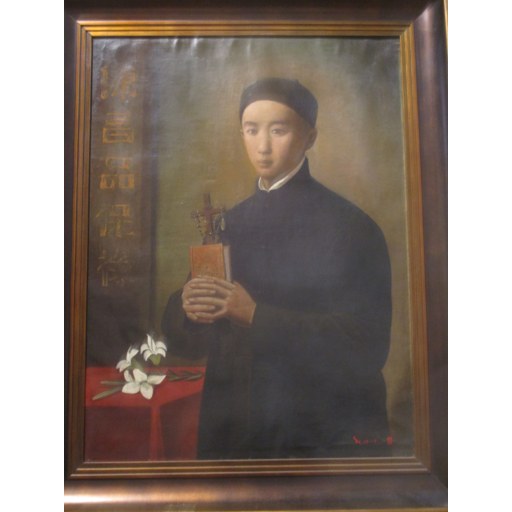
Unknown authorUnknown author
License: Public domain
Paul Tchen
Saint- Life Span
- 1838 - 1861 (age 23)
- Feast Day
- 9 July
- Gender
- male
- Church
- Catholic
Places
Roles & Family
Canonization
Biography
Paul Tchen, also known as Paul Chen Changpin (陈昌品), was a Chinese Catholic seminarian and martyr of the nineteenth century. He was born in 1838 in Qiantang, in Xingyi County of Guizhou province in southwestern China, then under the Qing dynasty. His family belonged to the small Catholic minority in a mountainous region where the faith had been planted by priests of the Paris Foreign Missions Society. For much of the eighteenth and early nineteenth centuries Christianity remained legally restricted, and Catholic households lived with social suspicion as well as periodic official hostility. In that setting, to raise a child in the Church already implied a measure of risk.
As a young man Tchen entered the seminary of the Apostolic Vicariate of Guizhou in order to prepare for the priesthood. Formation of native clergy was a stated aim of the missionary church, yet it was carried out under poor material conditions and political uncertainty. He studied alongside fellow seminarians Joseph Zhang Wenlan and John Baptist Luo Tingyin. The little community also depended on lay helpers; among them was the widow Martha Wang Luo Mande, who assisted the seminary. Surviving sources say little about Tchen’s daily routine or inner life; they attest chiefly that he was a seminarian of Guizhou who remained with his companions when persecution came.
In 1861 a local persecution of Christians broke out in the Guiyang area. Tchen, the two other seminarians, and Martha Wang were arrested and confined at Qingyan, a town south of the provincial capital. Missionary reports later used in the Roman process describe their refusal to apostatize under interrogation. On 29 July 1861 the four were put to death. Tchen was still in his early twenties. Their killing belongs to a wider pattern of violence against Catholics in several Chinese provinces during the nineteenth century, even after international treaties had in theory afforded Christianity greater legal protection.
The cause of the Qingyan martyrs of 1861 was introduced in Rome in the following decades. Pope Pius X beatified Paul Tchen and his three companions on 2 May 1909. On 1 October 2000 Pope John Paul II canonized them together with 116 other martyrs of China, from the seventeenth century to the 1930s, under the collective title of Saint Augustine Zhao Rong and Companions. The group is kept in the General Roman Calendar on 9 July. Tchen is thus honored as one of the early native Chinese candidates for the priesthood who chose death rather than denial of the faith.
In the memory of the Catholic Church in China, figures such as Tchen stand for the first generations of indigenous vocations that arose under missionary auspices and were tested by recurrent persecution. Devotion to the Chinese martyrs has been especially meaningful for Chinese Catholic communities, for whom these saints show both the cost of Christian discipleship in their own land and the continuity of the Church across centuries of political change. Precise details of Tchen’s childhood remain scarce; what is firmly attested is his identity as a Guizhou seminarian, his companionship with the other Qingyan martyrs, and the Church’s recognition of his martyrdom.