Paulus is a saint of the Catholic Church (d. 649). Paulus's feast day is celebrated on 8 February.
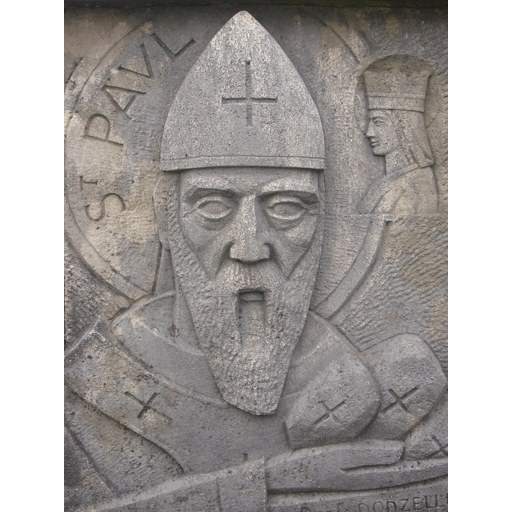
Rovo + Dante Donzelli
License: CC BY-SA 3.0
Paulus
Saint- Life Span
- d. 649
- Feast Day
- 8 February
- Gender
- male
- Church
- Catholic
Places
Relics & Where to Venerate
Location unknown
The bodily remains of Paulus are a first-class relic. Venerated at Verdun Cathedral.
Roles & Family
Biography
Paulus of Verdun, also called Paul of Verdun, was a seventh-century bishop of Verdun in the Frankish kingdom of Austrasia, in the Moselle region of what is now northeastern France. He belongs to the generation of Merovingian bishop-saints whose names survive in episcopal lists, martyrologies, and later vitae rather than in a dense contemporary archive. Reliable seventh-century documentation that names him is scarce; the outline of his career is therefore reconstructed from the diocesan succession of Verdun and from hagiographical tradition, including a Life written well after his death. He is placed in the see in the second quarter of the seventh century and is traditionally said to have died in 648 or 649. The Roman Martyrology commemorates him on 8 February as bishop of Verdun, noted for holiness of life and miracles.
Later medieval accounts describe him as coming from a noble or senatorial family. Some traditions, especially in French hagiography, associate his origins with Autun in Burgundy, but that birthplace is not confirmed by contemporary evidence and should be treated as unverified. He is said to have spent time at a royal court, often identified with that of King Dagobert I, before leaving secular life. One strand of the tradition presents him as a monk or hermit, and some writers link him with the monastery of Tholey in the Saar country before his elevation to the episcopate. These episodes follow a familiar pattern in Frankish saints’ lives of the period—court service, withdrawal, then pastoral office—and cannot be independently verified. No spouse or children are recorded; as a monk-bishop of this era he is understood to have lived in clerical celibacy.
As bishop he is remembered as a pastor who governed Verdun during a time when the Austrasian church was consolidating its diocesan structure and when Columbanian and other monastic currents were strong in the northeast of the Frankish realms. Hagiography credits him with zeal for his flock, support of religious life, and miracles, including wonder-working of a type common in early medieval vitae, such as provision of wine for laborers. The precise years of his episcopate are inferred from later catalogues rather than from a dated series of charters in his name. He would have worked in a landscape of river valleys, frontier fortresses, and emerging monastic houses along the Meuse and Moselle.
Paulus died at Verdun in the mid-seventh century and was buried there. His cult remained local: he appears in martyrologies as bishop of Verdun, and devotion to him was tied to the city and diocese through the Middle Ages. Because he lived long before the later medieval papal processes of beatification and canonization, he is honored as a saint by ancient cult rather than by a named papal act. Dates attached to his life, including the traditional death year, rest on liturgical and historiographical convention and are not fixed by a surviving contemporary obituary. What can be said with caution is that a holy bishop of Verdun named Paulus was venerated by the eighth of February, that his memory was preserved in the Gallic church, and that later ages elaborated a noble, courtly, and monastic background around a figure whose seventh-century traces are otherwise thin.