Pedro Arrupe is a servant of god of the Catholic Church (1907 - 1991).
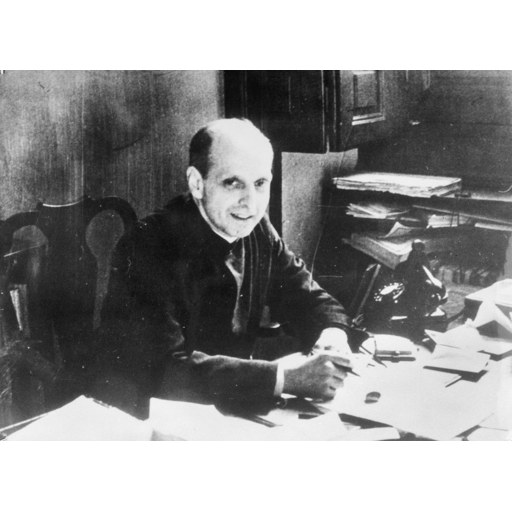
Anefo
License: CC0
Pedro Arrupe
Servant of God- Life Span
- 1907 - 1991 (age 84)
- Gender
- male
- Church
- Catholic
Places
Relics & Where to Venerate
Location unknown
The bodily remains of Pedro Arrupe are a first-class relic. Venerated at Church of the Gesù.
Roles & Family
Religious Information
Biography
Pedro Arrupe y Gondra was born in 1907 in Bilbao, in the Basque Country of Spain. He first studied medicine at the University of Madrid. A pilgrimage to Lourdes, where he believed he had witnessed miraculous healings, contributed to his decision to leave medicine for religious life. He entered the Society of Jesus in 1927. When the Spanish Republic dissolved the Jesuit order in Spain in the early 1930s, he continued his formation abroad, including studies in Belgium, the Netherlands, and the United States. He was ordained a priest in 1936. In 1938 he was sent as a missionary to Japan, where he learned the language and adapted to local culture.
After the outbreak of war in the Pacific he was briefly imprisoned as a suspected enemy alien, then released. In 1942 he became master of novices at the Jesuit novitiate at Nagatsuka, on the outskirts of Hiroshima. On 6 August 1945 he witnessed the atomic bombing of the city. Drawing on his medical training, he and the other Jesuits turned the damaged novitiate into a makeshift hospital and treated large numbers of burned and injured survivors with very limited supplies. The experience of mass civilian suffering marked his later spirituality and his insistence that faith must be joined to service of the wounded and the poor.
Arrupe became provincial superior of the Jesuits in Japan in 1958. In 1965, during the closing period of the Second Vatican Council, he was elected the twenty-eighth Superior General of the Society of Jesus, succeeding Jean-Baptiste Janssens. His generalate coincided with the post-conciliar renewal of the Catholic Church. He pressed the Society to unite the service of faith with the promotion of justice, and he popularized the ideal of forming “men and women for others,” notably in an address to Jesuit alumni in the 1970s. Under his leadership Jesuits expanded work among the poor and in social apostolate, a direction that won wide support inside the order but also produced tension with parts of the hierarchy and with the Holy See under Pope John Paul II.
In 1981 Arrupe suffered a severe stroke that left him unable to govern. Pope John Paul II appointed a pontifical delegate to oversee the Society until a successor could be chosen. Arrupe formally resigned in 1983, and Peter Hans Kolvenbach was elected Superior General. Arrupe spent his last years in the Jesuit infirmary in Rome, largely unable to speak. He died in Rome in 1991. His remains are in the Church of the Gesù. A cause for his beatification has been introduced and he is invoked by many as a Servant of God, but he has not been beatified or canonized, and he has no official feast day or patronages in the Catholic calendar.