Pedro de Arbués is a saint of the Catholic Church (1441 - 1485). Pedro de Arbués's feast day is celebrated on 17 September.
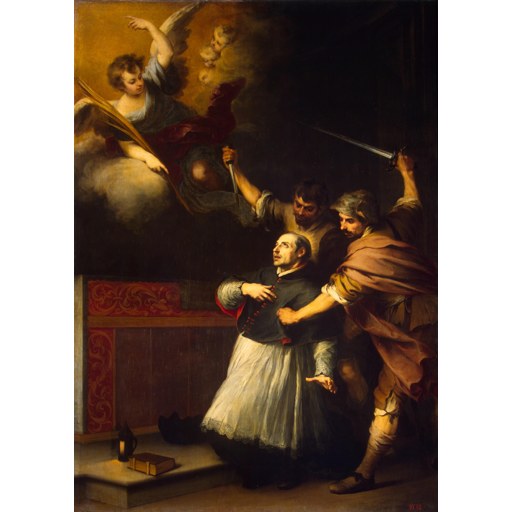
Bartolomé Esteban Murillo
License: Public domain
Pedro de Arbués
Saint- Life Span
- 1441 - 1485 (age 44)
- Feast Day
- 17 September
- Gender
- male
- Church
- Catholic
Places
Roles & Family
Canonization
Biography
Pedro de Arbués was born in 1441 in Épila, a town in the Kingdom of Aragon in what is now northeastern Spain. Traditional accounts place him in a family of the lesser nobility and name his parents as Antonio de Arbués and Sancia Ruiz. He received an education in the arts and theology in Aragon and then studied in Italy at the University of Bologna, where he obtained a doctorate in theology at the Spanish College of San Clemente, a college founded for students from the Iberian kingdoms. Later writers describe him as learned, personally austere, and strict in religious observance. After returning to Aragon he was appointed a canon of the metropolitan cathedral of Zaragoza, the church known as La Seo or the Cathedral of the Savior, and thus belonged to the senior secular clergy of the Crown of Aragon rather than to a mendicant or monastic order.
In 1478 the Spanish Inquisition was established in Castile under Ferdinand II of Aragon and Isabella I of Castile. In the 1480s the tribunal was extended into Aragon, where it met marked resistance. The kingdom had a strong tradition of customary law and parliamentary privilege, and many conversos—Christians of Jewish ancestry—held office, wealth, and influence in Zaragoza and other cities. In 1484 the Dominican Tomás de Torquemada, Inquisitor General, named Pedro de Arbués inquisitor for the Kingdom of Aragon. Arbués undertook investigations into alleged judaizing among conversos. Catholic hagiography presents him as a resolute guardian of orthodoxy. Historians also stress that opposition to him mixed religious, social, and constitutional motives, including Aragonese objection to a tribunal associated with Castilian royal power and operating under combined papal and royal authority.
As his activity intensified, threats against his life became frequent. According to the traditional narrative, he took to wearing a coat of mail and a steel cap beneath his choir dress when he attended the night office in the cathedral. In the night of 14–15 September 1485, while he was kneeling in prayer in La Seo, assassins attacked him. He was mortally wounded, reportedly in the neck and head, despite the armor. He died of those wounds on 17 September 1485 in Zaragoza. The crime was ascribed to a conspiracy among conversos who feared the Inquisition. Arrests, trials, and executions followed. The assassination produced a strong popular reaction in the city and, rather than crippling the tribunal, helped to consolidate it in Aragon under the protection of Ferdinand II.
Veneration of Arbués as a martyr began soon after his death. He was buried in La Seo Cathedral, where a tomb was later raised over his remains, and reports of miracles were collected in support of his cult. Pope Alexander VII beatified him in 1664. Pope Pius IX canonized him on 29 June 1867. The Catholic Church keeps his feast on 17 September. In later centuries his memory has been interpreted in sharply different ways: as a saint and martyr within Catholic tradition, and as a representative of inquisitorial coercion in critical historiography. Both the violence of his murder and the character of the office he held remain part of the historical record of late medieval Aragon.