Pelagia of Tarsus is a saint of the Catholic Church. Pelagia of Tarsus's feast day is celebrated on 4 May.
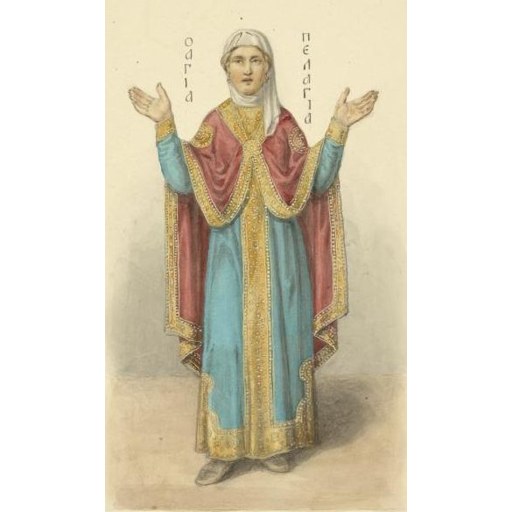
Solntsev, F. G. (1801-1892)
License: Public domain
Pelagia of Tarsus
Saint- Feast Day
- 4 May
- Gender
- female
- Church
- Catholic
Places
Roles & Family
Biography
Saint Pelagia of Tarsus is venerated as a Christian virgin martyr associated with Tarsus in Cilicia, in southeastern Asia Minor, during the later Roman Empire. The Roman Martyrology and the synaxaria of the Eastern churches place her passion in the reign of Emperor Diocletian (284–305). No contemporary documents survive, and modern historical scholarship treats the existing Acts as legendary, composed in the stereotyped manner of other late antique virgin-martyr narratives. She must be distinguished from other holy women of the same name, especially Pelagia the Penitent of Antioch (a converted actress, commemorated in October) and Pelagia the Virgin of Antioch; medieval calendars sometimes mixed their stories and feast days, which has made it harder to isolate any historical kernel.
In the traditional account, Pelagia was the daughter of illustrious pagan parents in Tarsus. She learned of Christianity from a Christian nurse and embraced belief in Christ, resolving to remain a virgin and to belong wholly to God. A young man of the imperial circle—described in some recensions as a son or adopted heir of Diocletian—became enamored of her beauty and sought her in marriage. When her mother urged the match, Pelagia declared that she was already betrothed to Christ, the Immortal Bridegroom. Her mother then reported her daughter’s Christian faith to the emperor, who sent soldiers to seize her. Asking leave to change her clothing, Pelagia instead went to the local bishop, named in the sources as Linus or Clinus, and received baptism. She distributed her possessions to the poor and presented herself to the imperial authorities.
According to the legend, Diocletian was struck by her appearance and tried both to win her for his son and to compel her to sacrifice to the gods. She refused marriage and refused apostasy. After torture she was enclosed in a bronze bull heated until it was red-hot, and there she died. Her bones were cast outside the city. The story relates that lions guarded the remains until Bishop Linus recovered them and gave them burial. A later layer of the tradition holds that during the reign of Constantine a church was built at Tarsus over her relics.
Pelagia of Tarsus is commemorated on 4 May in the Roman Martyrology and in the liturgical calendars of the Eastern Orthodox Church. In iconography she appears as a young woman; some images allude to martyrdom in the brazen bull, and a Western artistic type shows a female figure whose hair is seized by a demonic personification, a motif later painters associated with a Pelagia. Because the written Acts are late, uncorroborated, and conventional, historians cannot assign a verified year of birth or death, nor reconstruct a biography beyond the cult legend. Her feast and the association with Tarsus nevertheless belong to the early medieval memory of Cilician Christianity and to the wider late antique ideal of the virgin who prefers death to marriage with an unbeliever or to the denial of Christ.