Perpetua Hong Kŭm-ju is a saint of the Catholic Church.
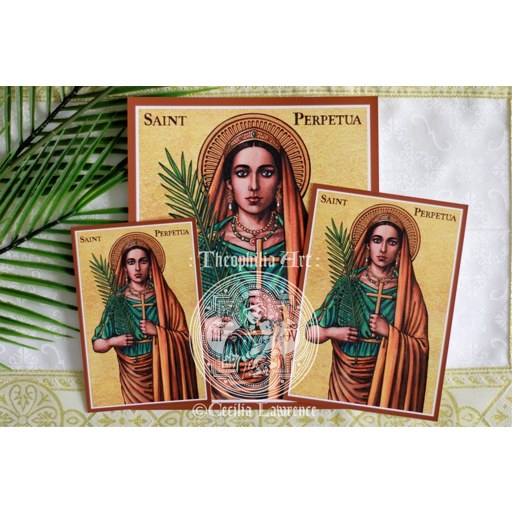
https://www.etsy.com/listing/1234654316/saint-perpetua-icon-catholic-theophilia
License: unknown
Perpetua Hong Kŭm-ju
Saint- Gender
- female
- Church
- Catholic
Places
Roles & Family
Biography
Perpetua Hong Kŭm-ju is recorded in Catholic onomastic and hagiographical lists as a Korean woman of the Joseon period who belonged to the Catholic community in Korea. Her name combines a Korean family and given name (Hong Kŭm-ju) with the baptismal name Perpetua, a pattern used by Korean Catholics from the late eighteenth century onward, when converts received a Christian name at baptism while retaining their Korean names. The baptismal name Perpetua recalls the North African martyr Saint Perpetua (early third century), whose passion was used in missionary catechesis. Reliable, source-critical publications in Western languages do not supply a verified year of birth, a verified year of death, a birth city, or a death city for this individual, and this notice therefore leaves those fields unset rather than inferring them from ages at martyrdom, persecution years, or office-taking dates.
The Catholic Church in Korea began in 1784, when the Confucian scholar Yi Sŭng-hun was baptized in Beijing and returned to form a community that for many years had no resident clergy. Lay men and women taught doctrine, copied books, baptized in danger of death, and sheltered believers. The Joseon state treated Catholicism as a challenge to ritual orthodoxy and to the authority of the throne. Major waves of persecution followed in 1791, 1801, 1839, 1846, and 1866, with further local outbreaks. Interrogation registers, death sentences, and later missionary correspondence are the principal contemporary sources. They name many women, including widows, wives of imprisoned converts, and unmarried catechists, but they do not always preserve enough detail for a full modern biography of each person later entered in martyrologies or in databases such as Wikidata.
The Holy See has given public liturgical honor to two large groups of Korean witnesses: 103 martyrs canonized by Pope John Paul II in Seoul on 6 May 1984 (commemorated in the General Roman Calendar on 20 September as Saints Andrew Kim Taegŏn, Paul Chŏng Hasang, and Companions), and 124 further martyrs beatified by Pope Francis on 16 August 2014 as Blessed Paul Yun Chi-chung and Companions. Countless other Korean Catholics died for the faith and have not been beatified. Published lists of the 103 canonized saints do not include a woman whose baptismal name is Perpetua. Whether Hong Kŭm-ju belongs to the 2014 group of blesseds, to a diocesan cause still in progress, or only to local memory is not established here from a source that can be cited with certainty. No religious order is documented for her; Korean Catholics of the persecution era were overwhelmingly laypeople. No spouse, marriage, or children are documented in the materials used for this notice.
Women in the early Korean church often kept the faith in households when men were arrested, instructed children and neighbors, and organized secret gathering places for prayer. Government records typically describe execution by beheading or strangulation, or death in prison, for those who refused to perform the prescribed rites or to denounce fellow believers. None of those circumstances can be assigned to Perpetua Hong Kŭm-ju without conjecture. Burial places of ordinary Korean martyrs were frequently unmarked; later shrines such as Jeoldusan in Seoul and Saenamteo gather relics and memory of many unnamed as well as named witnesses. No official patronage (of a place, profession, illness, or group) is attached to her in standard liturgical books.
This account therefore identifies Perpetua Hong Kŭm-ju only as a female Korean Catholic associated with the persecuted church of Joseon Korea, and it records the limits of the evidence. Precise dates, cities, marital status, children, religious profession, feast day, patronage, and the identity of any pope who may have beatified or canonized her are left blank where they cannot be verified from a reliable historical source.