Peter Damian is a saint of the Catholic Church (1007 - 1072). Peter Damian's feast day is celebrated on 21 February. Peter Damian is the patron saint of Faenza.
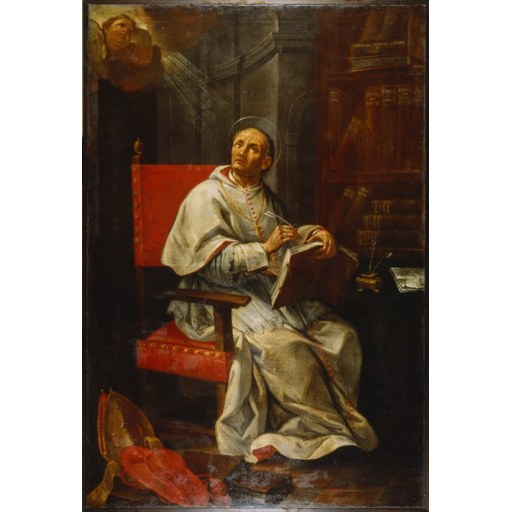
Andrea Barbiani
License: Public domain
Peter Damian
Saint- Life Span
- 1007 - 1072 (age 65)
- Feast Day
- 21 February
- Gender
- male
- Church
- Catholic
Places
Relics & Where to Venerate
Location unknown
The bodily remains of Peter Damian are a first-class relic. Venerated at Faenza Cathedral.
Roles & Family
Religious Information
Patronage
Faenza
Biography
Peter Damian (Latin Petrus Damianus; Italian Pietro or Pier Damiani) was born at Ravenna in the early eleventh century, conventionally dated to 1007, into a large family of modest means. Orphaned while still a child, he was at first neglected and put to menial work by one brother, then taken in, educated, and given his distinctive surname by another brother, Damianus, a priest. He studied the liberal arts at Ravenna, Faenza, and Parma and for a time taught rhetoric with success. Dissatisfied with a worldly academic career, he entered, in the mid-1030s, the hermitage of Fonte Avellana in the Apennines, a community of hermits living a severe life of prayer, fasting, and labor in the eremitical tradition associated with Saint Romuald of Ravenna.
As a monk and, from about 1043, as prior of Fonte Avellana, he became one of the chief moral and institutional reformers of the Latin Church in the eleventh century. He tightened discipline at the hermitage, founded or restored other houses, and wrote treatises and letters attacking simony, clerical marriage and concubinage, and sexual immorality among the clergy. His Liber Gomorrhianus, addressed to Pope Leo IX around the middle of the century, is the best known of these works. He also composed a life of Saint Romuald, sermons, liturgical texts, and a large correspondence that is a major source for the history of the reform papacy. His theological writings include a notable discussion of divine omnipotence and a relatively moderate position on the validity of sacraments celebrated by simoniacal priests. He practiced extreme personal austerities, including fasting and flagellation, while remaining an active public controversialist.
Against his wish to remain a hermit, Pope Stephen IX named him cardinal-bishop of Ostia in 1057. He then served repeatedly as papal legate: at Milan he confronted a powerful married clergy and the Patarine movement; he undertook missions in France and Germany; and he worked to strengthen reform popes and to mediate between the papacy and secular rulers, including the imperial court. He was a close adviser to Nicholas II and Alexander II, yet he continued to ask leave to resign the cardinalate and return to Fonte Avellana. In later years he was allowed to reside again at the hermitage, though he still accepted occasional diplomatic charges.
In 1072, returning from a mission intended to reconcile the church of Ravenna with Rome, he fell ill and died at Faenza on 22 February and was buried there; his relics were later associated with the cathedral of that city. Local veneration followed, and his reputation as ascetic, reformer, and theologian spread in later centuries; Dante placed him among the contemplative saints in the Paradiso. He was never pope or patriarch, lived as a monk without marriage or children, and is remembered as a driving force of the Gregorian Reform and as a major Latin spiritual writer of the central Middle Ages. Pope Leo XII declared him a Doctor of the Church in 1828. The Roman Church keeps his feast on 21 February.