Peter Igneus is a saint of the Catholic Church (d. 1089). Peter Igneus's feast day is celebrated on 8 February.
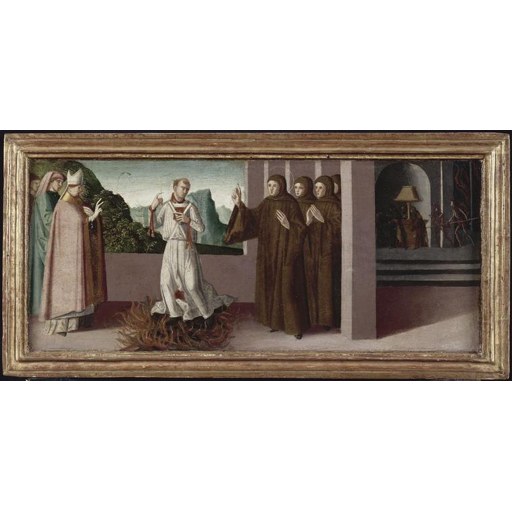
Marco Palmezzano
License: Public domain
Peter Igneus
Saint- Life Span
- d. 1089
- Feast Day
- 8 February
- Gender
- male
- Church
- Catholic
Places
Roles & Family
Religious Information
Biography
Peter Igneus, known in Italian as Pietro Igneo, was an eleventh-century Benedictine monk, abbot, and cardinal-bishop whose life became closely identified with the Vallombrosan reform and with the wider Gregorian campaign against simony. He was born in Florence in Tuscany; the year of his birth is not recorded in contemporary documents. Later tradition associated him with the Aldobrandini family. As a young man he entered the monastery of Vallombrosa, founded by Saint John Gualbert, and there he adopted the congregation’s austere interpretation of the Rule of Saint Benedict, which emphasized poverty, manual labor, and uncompromising opposition to the purchase of ecclesiastical office.
His reputation was sealed by an ordeal by fire, customarily dated to 1068, at the abbey of San Salvatore a Settimo near Florence. The Vallombrosan community had publicly accused Pietro Mezzabarba, bishop of Florence, of simony. When ordinary legal process failed to resolve the dispute, Peter undertook to walk between two great piles of burning wood. He passed through the flames unharmed, an event that contemporaries interpreted as a divine judgment. Bishop Mezzabarba was deposed, and Peter received the byname Igneus, “the fiery.” The episode was widely recounted in reform circles as a sign of God’s support for the monastic attack on corrupt prelates.
Thereafter Peter was appointed abbot of San Salvatore at Fucecchio. In 1072 Pope Alexander II named him cardinal-bishop of Albano, one of the seven suburbicarian sees that formed the inner circle of the Roman clergy. In that capacity he became a trusted agent of the papal reform. He served as legate in France and in the German kingdom, attended reforming councils, and worked to enforce clerical celibacy and the prohibition of simony. He stood with Pope Gregory VII during the Investiture Controversy and later took part in the elections of Victor III (1086) and Urban II (1088), remaining a link between the Tuscan Vallombrosans and the Roman Curia.
Peter Igneus died in 1089, on a day given by the sources as either 8 or 11 November. The precise place of his death and burial is not firmly established in the surviving records. Veneration of him as a saint arose soon afterward, especially within the Vallombrosan congregation and in Tuscany and the diocese of Albano. The Roman Martyrology lists his feast on 8 February, recalling the ordeal that earned him his name. No papal bull of formal canonization from the later centralized process is commonly cited; his cult belongs to the medieval pattern of local liturgical recognition later accepted by the universal Church.