Peter Mavimeno is a saint of the Catholic Church.
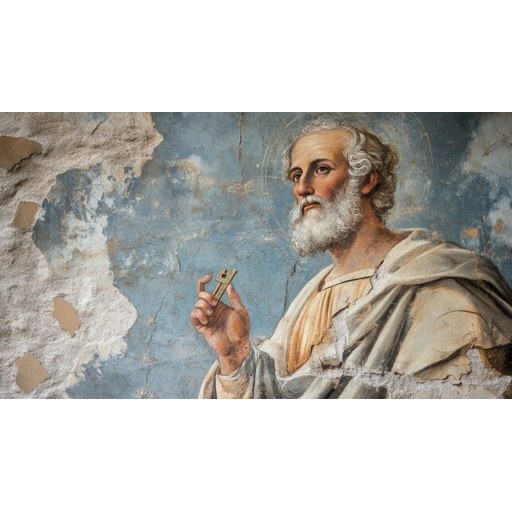
https://stock.adobe.com/search?k=saint+peter+painting
License: unknown
Peter Mavimeno
Saint- Gender
- male
- Church
- Catholic
Roles & Family
Biography
No reliably documented historical or hagiographical figure corresponding exactly to the name Peter Mavimeno has been identified in standard reference works. Major encyclopedias of saints, papal and patriarchal catalogues, Latin and Byzantine martyrologies, Coptic and other Eastern synaxaria, and widely cited biographical dictionaries do not record this precise name with a verifiable life. The lack of a Wikidata identifier and of a Wikipedia article is consistent with that obscurity. Without a securely identified person, dates of birth and death, places of origin or burial, and ecclesiastical career cannot be assigned. Historical method requires leaving those fields blank rather than filling them by conjecture or by borrowing dates from better-known men named Peter.
The given name Peter (Petros, Petrus, and related forms) is among the most common in Christian history, borne by the apostle, by numerous popes and patriarchs, and by countless local holy men. An epithet or surname resembling Mavimeno is not attested in the usual onomastic patterns of well-known saints. Possible explanations include a rare family name, a toponym referring to an unidentified locality, a transliteration from Greek, Slavic, or another language that has not entered Western scholarly literature, or a private individual rather than a public cult figure. None of these hypotheses can be confirmed from published sources. The name should not be conflated with documented Peters such as the Apostle, Peter of Alexandria, Peter Mogila, Peter the Athonite, or the popes of that name.
Because no vita, liturgical commemoration, inscription, or contemporary chronicle has been located, questions of religious order, marital status, children, canonization, beatification, feast day, and patronage cannot be answered from evidence. There is no indication that the subject occupied the papacy of Rome or of Alexandria, or a patriarchal or catholicosal see of the Orthodox, Oriental Orthodox, or Church of the East traditions; those offices are comprehensively listed in standard chronologies, and this name does not appear in them. If a purely local or oral tradition of sanctity exists, it has not been corroborated in accessible historical literature.
A responsible biographical notice must therefore remain largely negative: the subject cannot at present be placed in a century or a region with any confidence, and no reconstruction of education, ministry, or death can be offered. Further progress would depend on primary documentation—archival records, liturgical books, critical editions of lives of saints, or epigraphic finds—that would allow identification. Until such evidence appears, detailed narrative would be invention rather than history. Readers interested in attested figures named Peter should consult the established entries for those persons rather than treating Mavimeno as a variant of any of them.