Peter Nolasco is a saint of the Catholic Church (d. 1256). Peter Nolasco's feast day is celebrated on 28 January. Peter Nolasco is the patron saint of captives;prisoners;the Mercedarian Order.
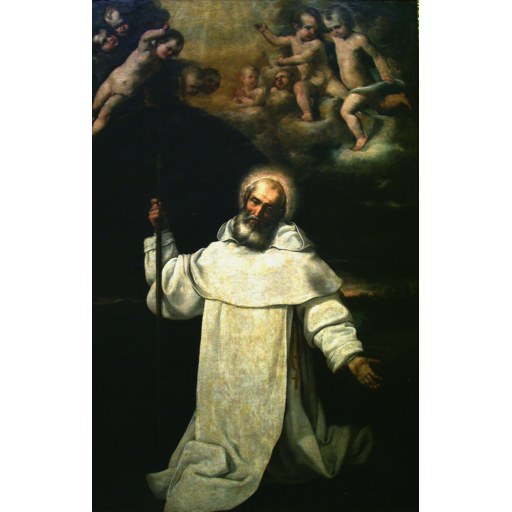
Jusepe Martínez
License: Public domain
Peter Nolasco
Saint- Life Span
- d. 1256
- Feast Day
- 28 January
- Gender
- male
- Church
- Catholic
Places
Roles & Family
Religious Information
Patronage
captives;prisoners;the Mercedarian Order
Canonization
Biography
Peter Nolasco is venerated as the founder of the Order of the Blessed Virgin Mary of Mercy, commonly called the Mercedarians, a religious institute of the thirteenth century devoted to the ransom of Christian captives held in Muslim lands. Almost everything alleged about his childhood and youth comes from later hagiography rather than from documents of his own lifetime, and modern historians have treated the conventional dates and anecdotes with caution. The received account places his birth toward the close of the twelfth century at Mas-Saintes-Puelles in Languedoc, in what is now southern France; Catalan tradition has sometimes claimed Barcelona instead. He is described as coming of a family of some means and as settling in Barcelona, then a principal port of the Crown of Aragon, where the buying and selling of captives taken in frontier war and piracy was a familiar public fact. There, according to the same tradition, he spent his fortune purchasing the freedom of Christians enslaved in al-Andalus and North Africa before giving that work a permanent religious form.
Hagiography holds that in 1218 he received a mandate, linked to an apparition of the Blessed Virgin Mary, to found an order dedicated to the redemption of captives. King James I of Aragon is presented as royal patron of the new institute, and the canonist Raymond of Penyafort as adviser in shaping its rule. Historically the community is attested in Barcelona in the 1220s and received papal confirmation from Gregory IX in 1235. The Mercedarians combined features of a military order with those of a religious congregation: members took the ordinary three vows and a distinctive fourth vow to offer themselves, if need be, as hostages in place of captives whose faith was in danger. Peter Nolasco was the first master general. Whether he was ordained or remained a lay founder is not settled by the earliest evidence; later piety often portrayed him as a priest, while some historians regard him as a layman who organized ransom as a work of mercy.
Under his direction the order established houses in the Crown of Aragon and beyond and sent expeditions to negotiate and pay ransoms. That activity belonged to a wider Mediterranean practice in which merchants, municipalities, and confraternities all took part; the Mercedarians gave it a stable institutional and religious shape. Peter Nolasco appears in a number of thirteenth-century documents concerned with the order’s property and ransoming, but the record is too thin for a year-by-year biography. He is generally held to have died in Barcelona in the mid-thirteenth century, most often in 1256, and to have been buried in the Mercedarian convent there. His relics are associated with the later Basilica of La Mercè in Barcelona.
Devotion to him grew with the expansion of his order. He was canonized by Pope Urban VIII in 1628. His feast, long kept on 6 May in the general calendar of the Roman Rite and still observed on that date by the Mercedarians, is now commonly listed on 28 January. He is invoked as patron of captives and prisoners and remains the principal saint of the Mercedarian family. The historical figure is best understood as a thirteenth-century organizer of ransom in the Catalan-Aragonese world whose life was later recast in the language of Marian vision, royal foundation, and heroic self-offering characteristic of late medieval and baroque hagiography.