Peter the Hermit of Galatia is a venerable of the Catholic Church.
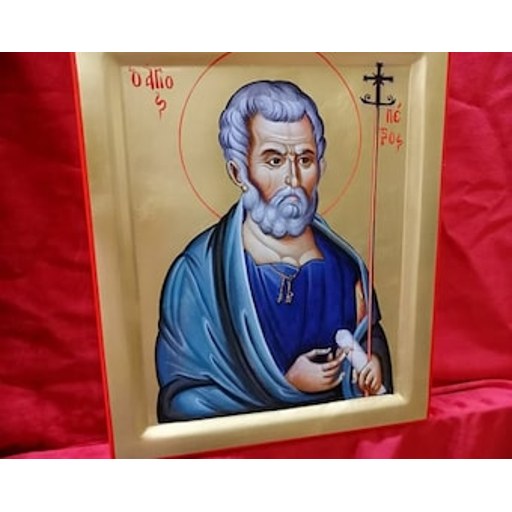
https://etsy.com/listing/785966761/saint-st-peter-the-apostle-icon-greek
License: unknown
Peter the Hermit of Galatia
Venerable- Gender
- male
- Church
- Catholic
Places
Roles & Family
Biography
Peter the Hermit of Galatia, also called Peter of Galatia or Peter the Galatian, was a Christian hermit of the late fourth and early fifth centuries. Almost everything that can be said of him with any historical control comes from a single source: the Historia Religiosa (Religious History) of Theodoret of Cyrrhus, a collection of portraits of Syrian monks written in the 430s or 440s. Theodoret identifies Peter as a Galatian by birth, that is, a native of the Roman province of Galatia in central Asia Minor. No reliable source records the year of his birth, the name of his native town, or anything about his family. At an unknown date he left Galatia and settled in the countryside around Antioch on the Orontes, then one of the principal cities of the Eastern Roman Empire and a major centre of Christian life and monastic experiment.
According to Theodoret, Peter took up residence in a tomb outside Antioch and remained in that dwelling for many years. His way of life belonged to the severe Syrian eremitical tradition of the period: a diet of bread and water, coarse clothing, and long continuance in prayer and withdrawal. Occupying a tomb as a cell, a practice attested for other Syrian hermits as well, expressed a deliberate dying to the world. From that retreat he nevertheless received visitors who sought healing of illness, deliverance from what the sources describe as demonic affliction, and spiritual counsel. Theodoret, writing in the hagiographical manner of his age, attributes to Peter gifts of healing and discernment. Those claims cannot be independently verified, but they show how Peter was remembered in the Antiochene Christian community of the early fifth century.
Theodoret’s account is not that of a distant compiler. He relates that his own mother, a devout woman of Antioch, used to visit the hermit and that she brought Theodoret to him when Theodoret was still a child. Peter laid his hand on the boy’s head and blessed him. Theodoret was born in Antioch in the last decade of the fourth century, so the visit belongs to the years around the turn of the fifth century, when Peter was already an established local holy man. By the time Theodoret composed the Historia Religiosa, Peter appears already to have died. The work gives no exact year of death. Later menologia and synaxaria sometimes assign a date in the early fifth century, but that figure is traditional rather than demonstrated by a contemporary chronicle. He died at or near Antioch; the place of burial is not recorded in Theodoret.
Peter belongs to the same monastic world as the other figures of the Historia Religiosa: caves, huts, and tombs in the hills and plains around Antioch and neighbouring Syrian districts, in the generations after the legalisation of Christianity. He held no episcopal office, was neither pope nor patriarch, and did not belong to a later-style religious order; he lived as an independent hermit. Consistent with that vocation, no spouse or children are mentioned. He must not be confused with Peter the Hermit of Amiens, the eleventh-century preacher of the First Crusade. Eastern calendars have at times commemorated a Peter of Galatia, but it is not always clear whether every such entry refers to the Antiochene hermit described by Theodoret or to other homonymous ascetics, including a Peter of Galatia associated in some later legends with Constantinople. No papal canonization in the medieval or modern sense exists for this fifth-century figure; his reputation as a saint rests on local veneration and on Theodoret’s portrait. Specific patronages are not securely attested in the earliest sources.