Philastrius is a saint of the Catholic Church. Philastrius's feast day is celebrated on 18 July.
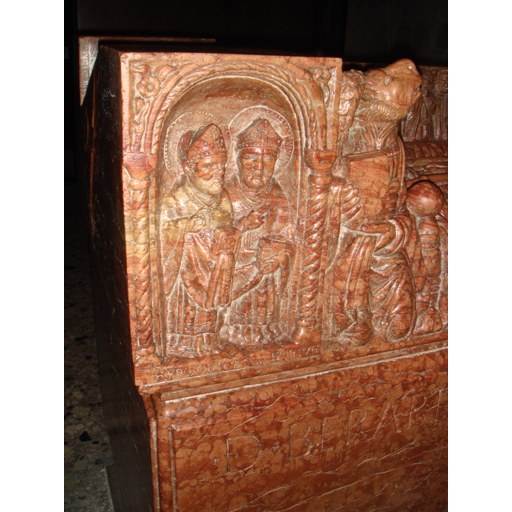
Stefano Bolognini
License: Attribution
Philastrius
Saint- Feast Day
- 18 July
- Gender
- male
- Church
- Catholic
Places
Relics & Where to Venerate
Location unknown
The bodily remains of Philastrius are a first-class relic. Venerated at Duomo Nuovo.
Roles & Family
Biography
Philastrius, also known as Philaster, Filaster, or Filastrius, was a bishop of Brescia in northern Italy during the later fourth century and the author of an early Latin catalogue of heresies. Almost nothing can be established with certainty about his origins. Neither the year nor the place of his birth is recorded in surviving sources. The principal witness to his life is a sermon delivered by his successor, Saint Gaudentius of Brescia, on an anniversary of Philastrius's death. Gaudentius describes him as a man who left his homeland, parents, and relatives in order to preach the Christian faith. According to this account, Philastrius traveled widely through the Roman world, confronting pagans and Jews as well as Christian heretics, and he endured persecution and corporal punishment, including scourging, for his opposition to heresy.
Before he became bishop of Brescia, Philastrius is reported to have worked in Rome and then in Milan, where he opposed Arian teaching during the episcopate of the Arian bishop Auxentius. He was chosen bishop of Brescia, most likely around the year 380. In 381 he took part in the Council of Aquileia, which met under the leadership of Saint Ambrose of Milan and condemned the Arian bishops Palladius of Ratiaria and Secundianus of Singidunum. Saint Augustine of Hippo later recalled having seen Philastrius at Milan, an encounter that must have occurred in the mid-380s, while Augustine was still teaching rhetoric in that city and had not yet been baptized. These notices place Philastrius firmly in the network of Western anti-Arian bishops associated with Ambrose.
Philastrius's only extant work is the Diversarum Hereseon Liber, or Book of Diverse Heresies, composed around 383 or in the years immediately following. The treatise enumerates 156 heresies in the usual numbering, beginning with sects among the Jews and continuing through a long series of Christian deviations from apostolic teaching. The work is an important, if uneven, source for the history of early Christian heterodoxy. It is generally regarded as less critical and less systematically arranged than the contemporary Greek Panarion of Epiphanius of Salamis. Augustine, writing his own De haeresibus decades later, made use of Philastrius's catalogue together with that of Epiphanius, while noting shortcomings in Philastrius's information and method. Despite its limitations, the Liber remains a significant document of fourth-century Latin heresiology and of the pastoral concern of a North Italian bishop to identify and refute error.
The precise year of Philastrius's death is not known. It is customarily placed in the late fourth century, with proposed dates clustering around the later 380s or about 397. Gaudentius succeeded him in the see of Brescia and was consecrated by Ambrose; Gaudentius's commemorative sermon, preached on the fourteenth anniversary of his predecessor's death, praises Philastrius's apostolic labors, his defense of orthodoxy, and his care for the flock. Philastrius has been venerated as a saint in the church of Brescia from an early period. His feast is observed on 18 July. Beyond the outline preserved by Gaudentius, the acts of the Council of Aquileia, Augustine's brief notices, and the internal evidence of the Liber, many details of his biography remain obscure, and later legendary elaborations cannot be verified.