Philip of Agira is a saint of the Catholic Church (d. 453). Philip of Agira's feast day is celebrated on 12 May. Philip of Agira is the patron saint of Agira;Aci Catena;San Filippo del Mela;Limina;Mongiuffi Melia;those possessed by evil spirits.
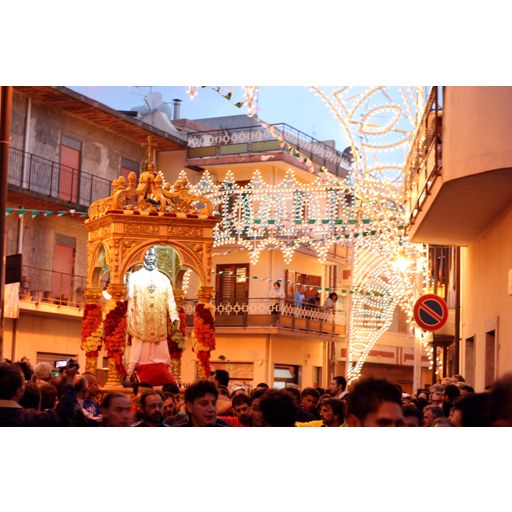
fa.b
License: CC BY-SA 2.0
Philip of Agira
Saint- Life Span
- d. 453
- Feast Day
- 12 May
- Gender
- male
- Church
- Catholic
Places

Roles & Family
Patronage
Agira;Aci Catena;San Filippo del Mela;Limina;Mongiuffi Melia;those possessed by evil spirits
Biography
Philip of Agira (Italian: Filippo d'Agira; also called Philip of Agyrium) is a Christian priest-saint whose cult is centered on the inland Sicilian town of Agira, the ancient Agyrium. Almost everything reported about his life depends on later hagiography, above all a Latin Vita ascribed to a writer named Eusebius, a text that scholars regard as largely legendary and composed well after the events it claims to describe. Because of that, historians treat him as a figure of late antiquity—most often of the fifth century—around whom memories of an early missionary priest and exorcist coalesced, rather than as a person whose career can be reconstructed from contemporary documents. Popular tradition sometimes pushed him back into the apostolic age and made him a disciple sent to Sicily by Saint Peter, but that chronology is incompatible with the more usual fifth-century setting and is not historically credible.
According to the traditional narrative, Philip was born in the Greek East, the sources disagreeing between Thrace and Cappadocia, and was of Syrian parentage (the names Theodosius and Basilissa are sometimes given for his parents). He is said to have received a Christian formation, to have been ordained priest, and to have been dispatched to Sicily—in some versions by a bishop of Rome—to preach, to confront remaining pagan cults, and to free people believed to be possessed. The Vita presents him as a wandering wonder-worker and exorcist who moved through the island destroying idols, converting communities, and performing healings. His ministry is especially tied to Agyrium, where he is said to have settled and where he died. No reliable source records a wife or children; he is remembered as a celibate priest, not as a member of a later named religious order, and he never held the offices of pope or patriarch.
The date of death handed down in martyrologies and local tradition is 12 May, commonly assigned to the year 453, though that year cannot be confirmed independently of the hagiographical tradition. He was buried at Agira, and his tomb became the nucleus of a lasting cult. Relics associated with him are kept in the sanctuary church dedicated to him in Agira, long a pilgrimage site for central Sicily. His feast is observed on 12 May. In the Byzantine period and after the Latin restoration of the island, devotion to San Filippo d'Agira spread through Sicily and into parts of southern Italy. He is the principal patron of Agira and is also venerated as patron in several other Sicilian communities, including Aci Catena, San Filippo del Mela, Limina, and Mongiuffi Melia, and he is widely invoked against demonic possession and evil spirits.
Because the written Life is late and filled with conventional miracle stories, the safest historical judgment is modest: Sicily in late antiquity knew a priestly cult of a holy man named Philip at Agyrium, and that cult, reshaped by medieval hagiographers, made him one of the characteristic local saints of the island. Formal papal canonization in the later medieval or modern sense did not apply; his recognition belongs to the era of popular acclamation and episcopal cult (so-called pre-congregation sainthood). The combination of an obscure biography with a very concrete local shrine explains both the richness of the legends and the thinness of the verifiable facts.